Hello friends,
Hope you’ve all been finding a way to beat the heat. I will share with you that I find that one of the best ways to beat the heat is to knit. Then again, I find that adding knitting to anything and everything tends to help… so, admittedly, this may not be the most earth-shattering piece of advice you get today. But there it is.
In today’s newsletter, I am continuing the chronicling of the knitting of Spycraft, the play Claire Dunn and I wrote and then produced last November about a kick-ass woman in her 50s who was tapped by the Special Operations Executive (SOE) to spy on the Wehrmacht in Occupied France in WWII, and in addition to hiding coded intelligence in her knitting, managed a wicked Nazi take-down along the way.
To date, we’ve covered the stories behind the knitting and coding of the Lions Waistcoat worn by Spycraft character Gerald Butterfield (Devin Lee), Simon Rawlings’ (Blair Williams) SOE vest, June Grey’s (Charlotte Dennis) Secretary Sweater, and Audette Whitlock’s (Diane Flacks) Diamonds sweater. That leaves one sweater to go – the one worn by Sophie, Audette’s great granddaughter.
The major design consideration of Sophie’s sweater was entirely practical: it had to be loose fitting. This is because the actor (Charlotte Dennis) who was playing Sophie was also playing June and had a serious quick-change to move from playing one to the other (and back again, if memory serves). To help with this, Charlotte needed to have elements of June’s costume underdressed when she started the show as Sophie. Nick Blais, our designer, and I talked about a sweater that would allow for underdressing and be relatively easy to get on and off – something comfy, relaxed, and over-sized. “Sure,” I said, “I can do that,” having no idea what I was looking for.
I cast about on the internet to find a pattern that was close to what we discussed and came up with the Ozetta Winters pullover.
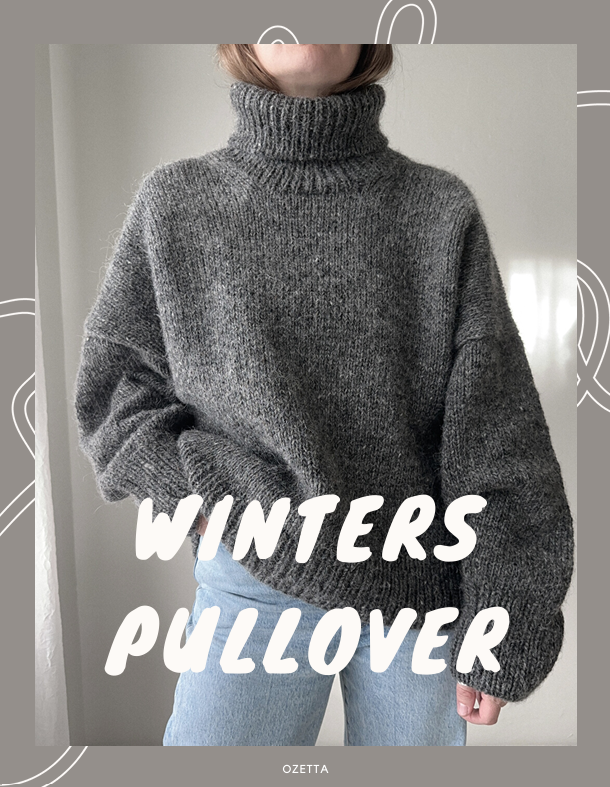
Nick loved it. Great! The next step was to figure out how to put code into it. Less great. The body and sleeves of the sweater were a monochrome of stockinette stitch. No multiple colours, nowhere to hide fancy stitches. The only place that just might work was the ribbing, because nobody ever pays any attention to ribbing. The Winters pullover had a standard K1 P1 rib on the sleeve cuffs, the body cuff, and around the neck. But what if I tried to sneak some morse code in there? I went with a column of Knit 1 (K1) ribbing for a dot, and a column of K2 ribbing for a dash. A column of Purl 1 (P1) would be the space between dots and dashes of a letter, a column of P2 would be the space between letters, and a column of P3 would be the space between words.
As a test, I used a short quote from Bernie Sanders, which just happened to fit around the cuff of one of the sleeves. See if you can figure it out, reading left to right, using standard Morse Code, which I’ve included just below the ribbing. To start you off, I’ll tell you that the first letter is an ‘N.’
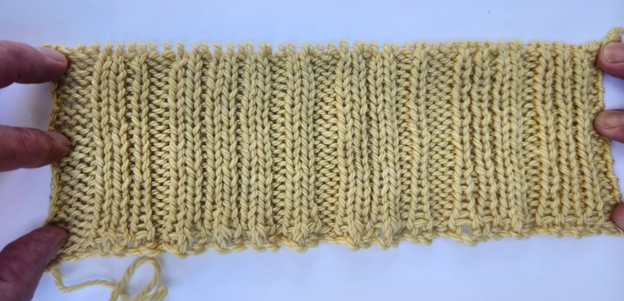
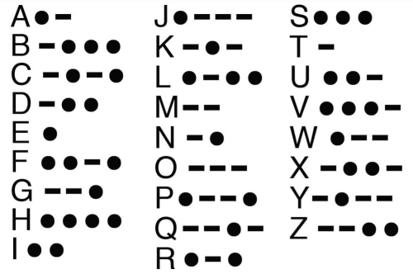
The message, as you’ve likely uncovered, is “not me, us.” Okay, full transparency, technically there should be a comma between the “me” and the “us,” but a comma in Morse Code is two dashes, two dots, and then another two dashes. Who’s got the space for all that?
I decided not to hide any code in the ribbing around the neck, as that would be too close to the actor’s face, which is where everyone would be looking. I was afraid that some intrepid knitter might give the collar a close look, wonder what the heck was going on with the ribbing, and the jig would be up.
In thinking of a good quote for the character of Sophie, who is a budding social activist, Claire and I decided on “The only thing necessary for the triumph of evil is for good men to do nothing,” which can be traced back to John Stuart Mill, who said in 1867 "Bad men need nothing more to compass their ends, than that good men should look on and do nothing."
Of course, that’s a lot of letters and I only had a finite number of stitches to work with, so I got it down to “Evil triumphs when the good do nothing.” This phrase started on the left cuff of the sweater and was finished in the cuff around the body. I used the Bernie Sanders quote for the right cuff.
As I was run off my feet knitting the Secretary Sweater (see my last newsletter), I needed to farm this item out. I dropped a line to my high school friend Mark Cayen, with whom I had lost touch until recently when I discovered that he was heavily into the fibre arts. Mark, who goes by the handle Pepere, does exquisite work in handbags, cases, and pillows. You can check out his work here.
Mark was totally up for it. Nice!
We decided to knit Sophie’s sweater in a beautiful coral shade, hand-dyed by my good friends at Cabin Boy Knits, an Ontario dyer who just happens to be located a mere 8 km from the Stirling Festival Theatre where we would be premiering Spycraft. Christopher Walker and Jamie Godin of Cabin Boy provided us with a gorgeous merino blend, which Christopher handed off to me on a summer day in downtown Toronto.
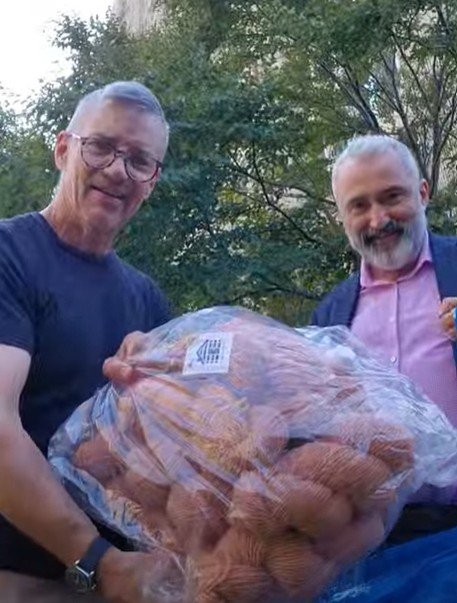
I, in turn, passed the Cabin Boy Coral Merino along to Mark, who got to work on his knitting machine.
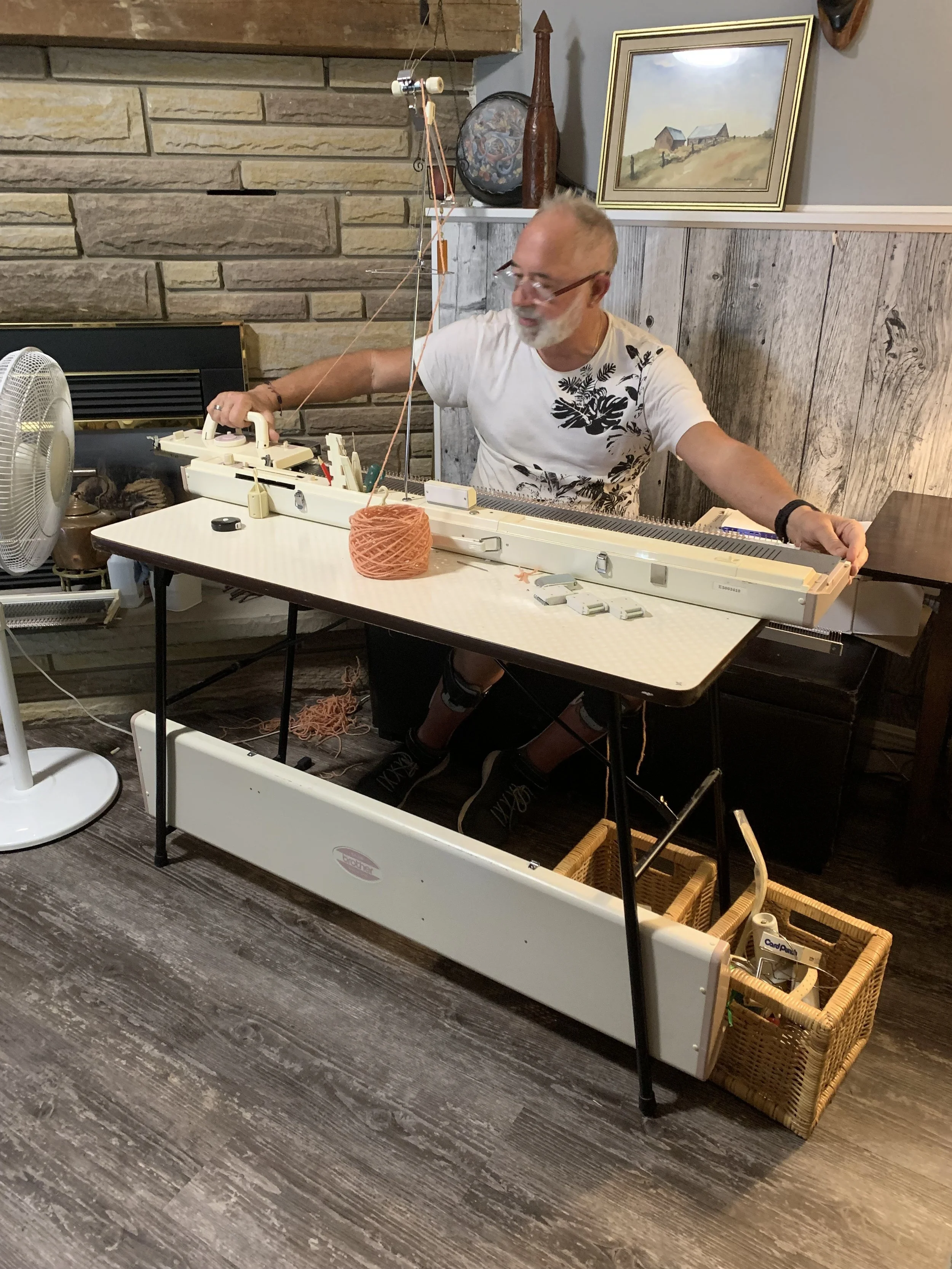
And here’s what Mark knitted, as modeled by Charlotte:
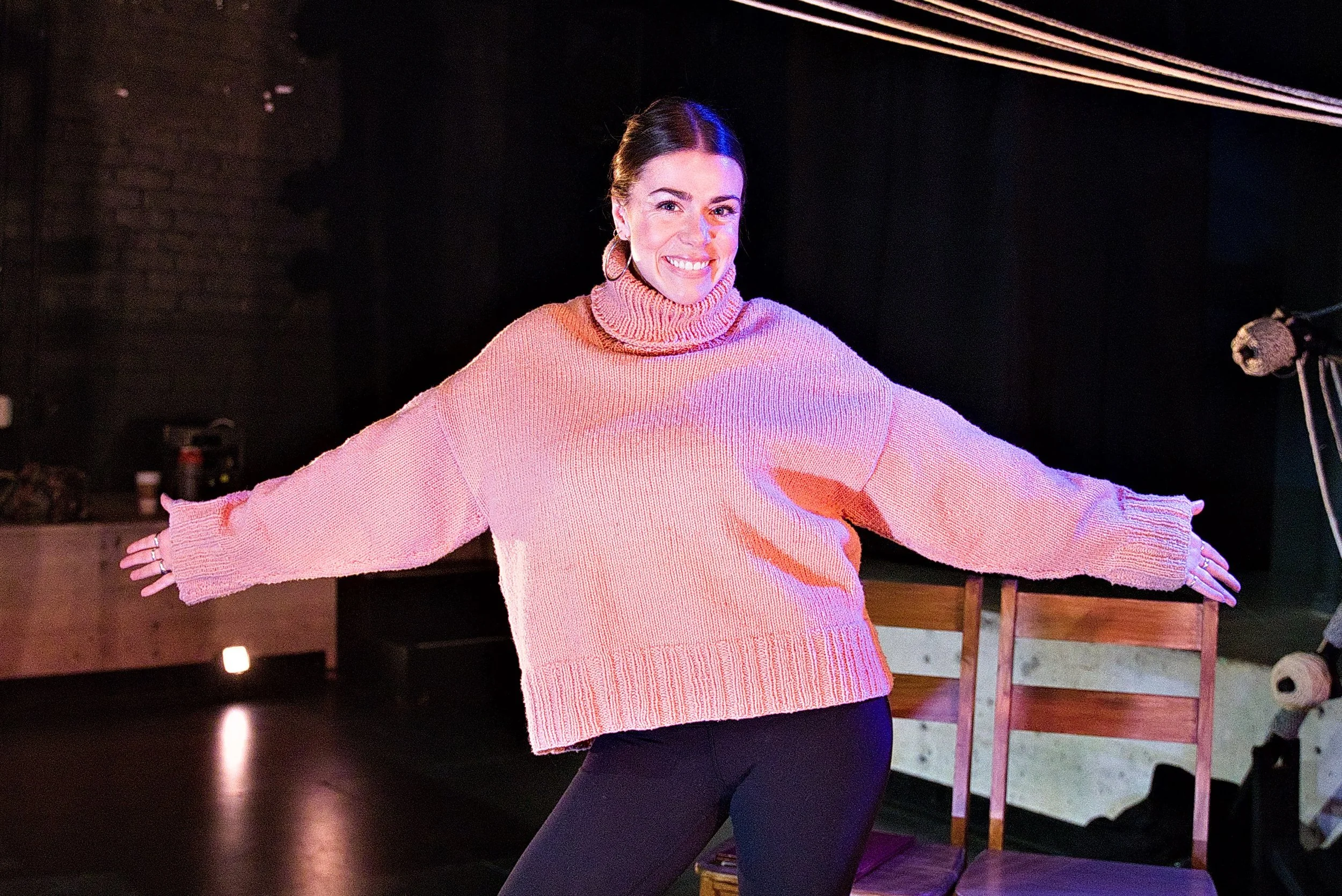
Of all the sweaters in the show, Sophie’s was likely the one that hid its code the best. So, a note to all you knitting coders out there who love monochrome and don’t want to be bothered with intarsia: coded cuffs may be the way to go.
What’s on my Needles (well, just off my needles…)
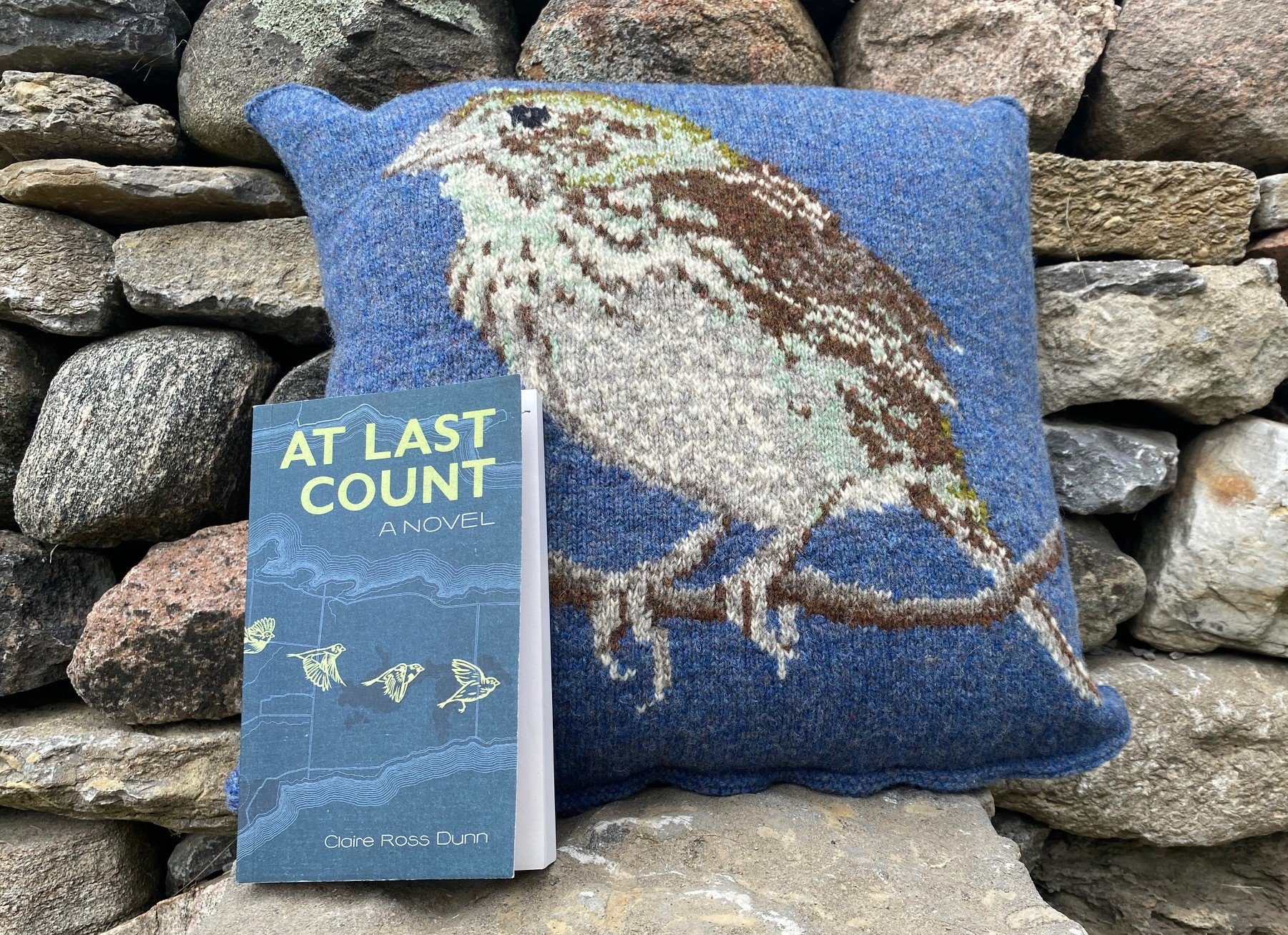
As you may have heard me mention, my brilliant wife Claire has recently published her second novel, Lost in France. In honour of her first novel, At Last Count, I knit a pillow featuring the Henslow’s Sparrow, a bird that was integral to the story.
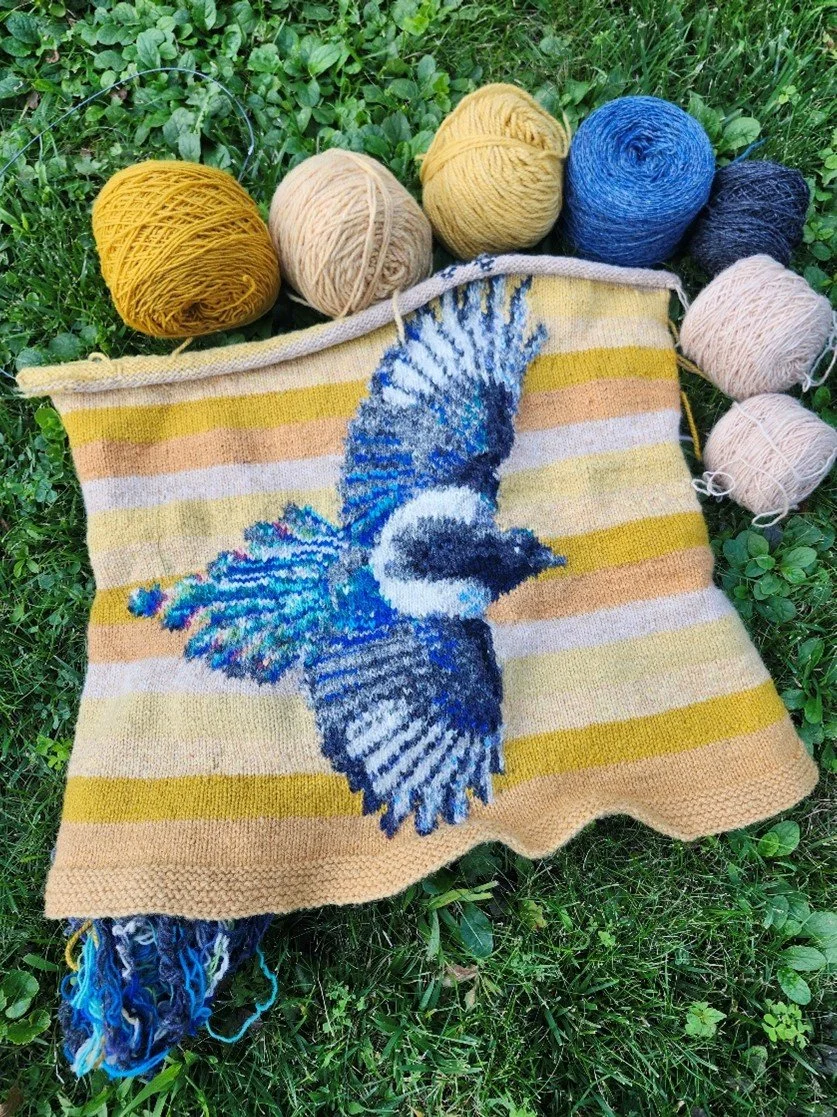
In Lost in France, another bird makes an appearance – a Magpie. And so, in keeping with this (albeit short) tradition, I have knit a pillow of the Lost in France Magpie. For the bird, I used sport weight yarn (doubled) from Briggs & Little, and the background is a combination of worsted weight yarn from both Briggs & Little and Cabin Boy Knits. It’s just about done (except for the back, sewing in the ends, and the assembly. Okay, it’s nowhere near done). Here it is:
That’s it for now. Next time we’ll move on to the props of Spycraft and take a look at what secrets they have been keeping.
Thanks for reading friends,
Keep knitting!