Hey there, friends,
I hope everyone’s summer has been good. At this time of year, I try to keep in mind that – technically – summer lasts until September 21st. That helps me deal with the “where did it go?” bewilderment that hits me right around now. And, if you are not going back to school (or your kids or family members are not going back to school), September is pretty much the perfect time to take a holiday. You get that fading warmth of summer, with absolutely nobody around. Delightful.
In this newsletter, we are picking up the Spycraft chronicles where we left off. In past newsletters, we have looked at the design, coding, and knitting of the sweaters we used in the show Claire Dunn and I wrote about a woman in WW2 who – in her 50s – becomes a badass espionage agent for the British Special Operations Executive in Occupied France by spying on the Nazis. Now it is time to look at some to the props of the show and see what secrets they may have been hiding.
First up are the socks. Our lead, Audette (played by (Diane Flacks), smuggled military intelligence back to London by knitting code into socks. The script tells us she did this a lot. This meant that we needed to have a lot of socks to demonstrate this was true. As noted in previous newsletters, the timeline for producing a play is a few short weeks, which is not much time to knit a whole lot of socks. We needed help. So, I reached out to the knitting community over social media (check out my posts on instagram, or facebook) to invite contributions. Ideally, the socks would have some sort of code in them, but we also acknowledged that it would be impossible for the audience to distinguish any code from their seats during the show, so we would accept any hand-knitted donations. Nonetheless, if there were any intrepid knitters who wanted to try their hand at coding, I came up with a couple of diagrams outlining a few coding options.
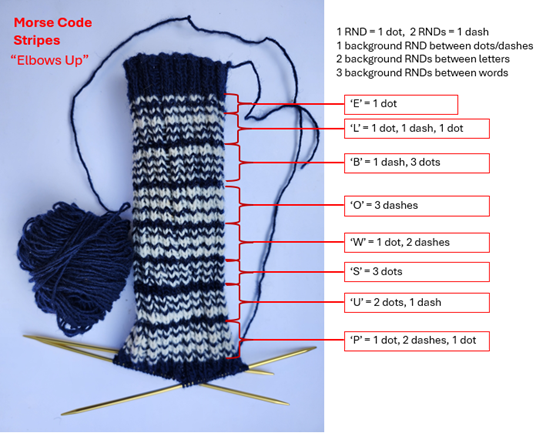
Below is my first design: standard Morse code, in stripes. One row of white is a dot, and two rows of white are a dash. The background is navy. One row of navy between dots and dashes, two rows between letters, three rows between words. The message gives a bit of a hint about what was going on in the world when I knit it.
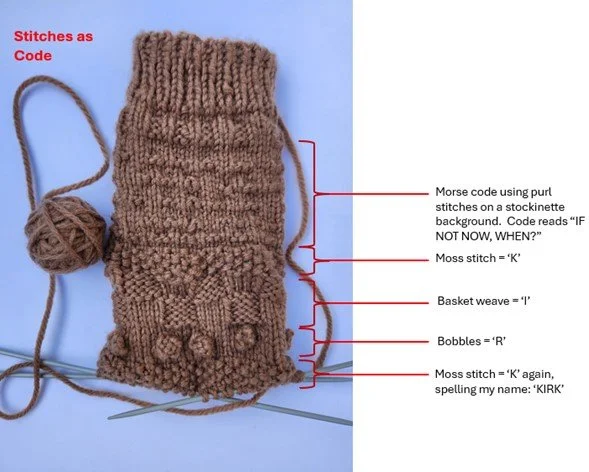
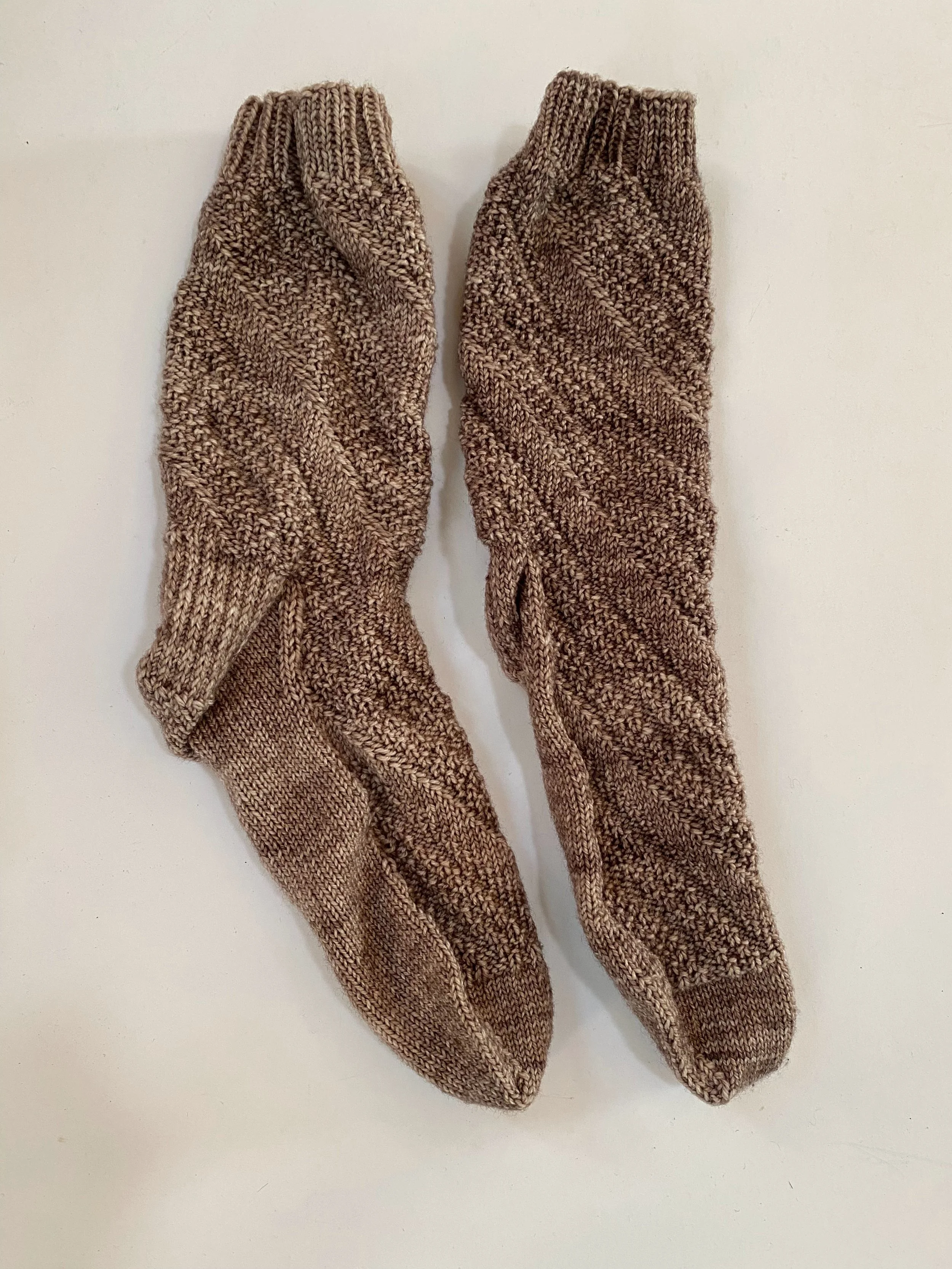
Next, I tried to hide some code in different kinds of stitches. First, I tried Morse Code using purl stitches on a basic stockinette (flat) background. One purl was a dot, two were a dash. But as you can see at the top of the tan sock in the photo below, that technique got pretty muddy, pretty quickly. I was obliged to place at least two knit stitches between the dots and dashes, four knit stitches between the letters, and six knit stitches between the words. Even when I spaced it out that much, it was very hard to read.
In the same sock, I then used different types of stitch patterns to represent different letters. I only needed three different stitch patterns to spell my name, which was good, because I don’t know if I could find 26 distinct stitch patterns to cover the whole alphabet.
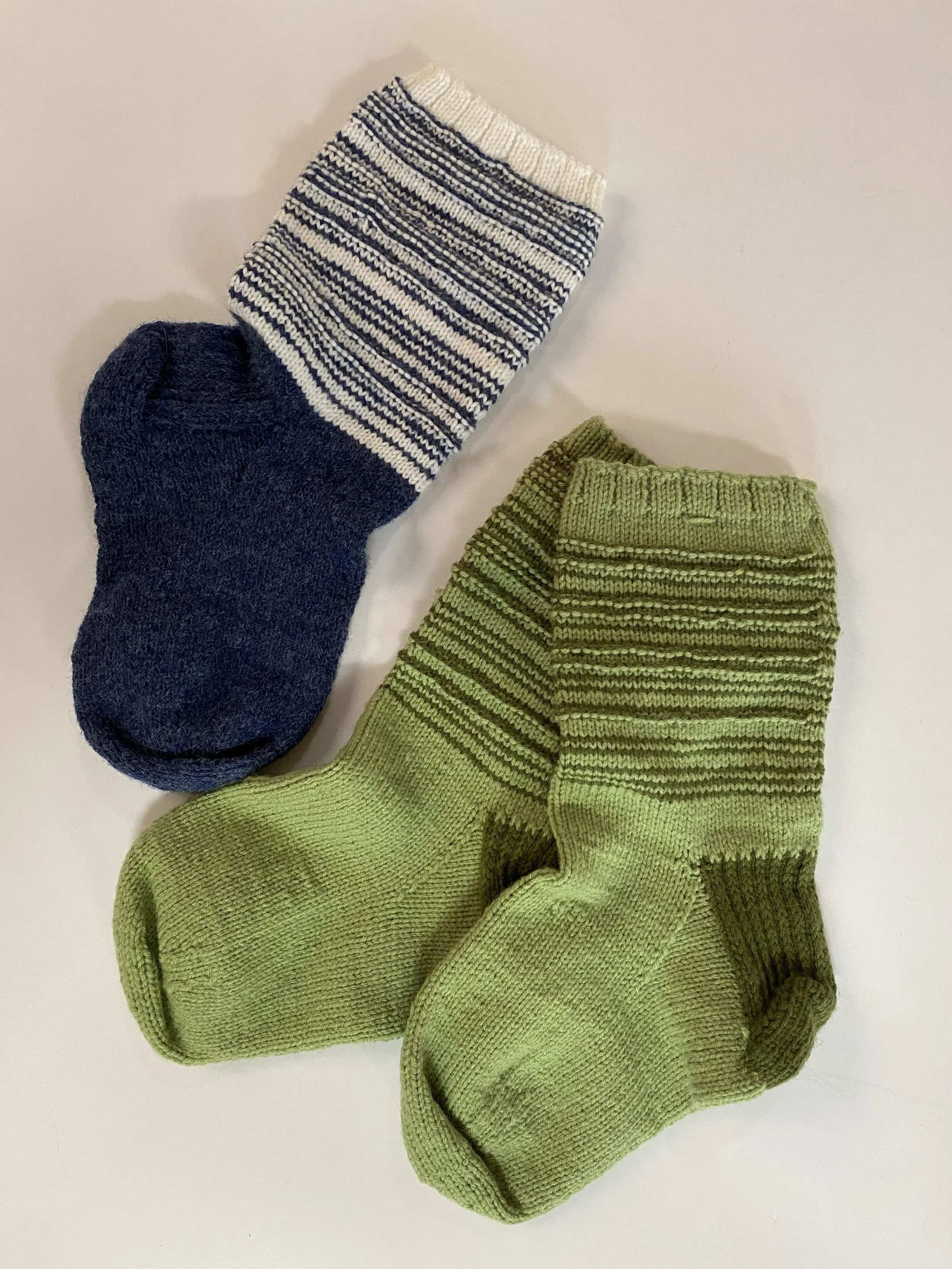
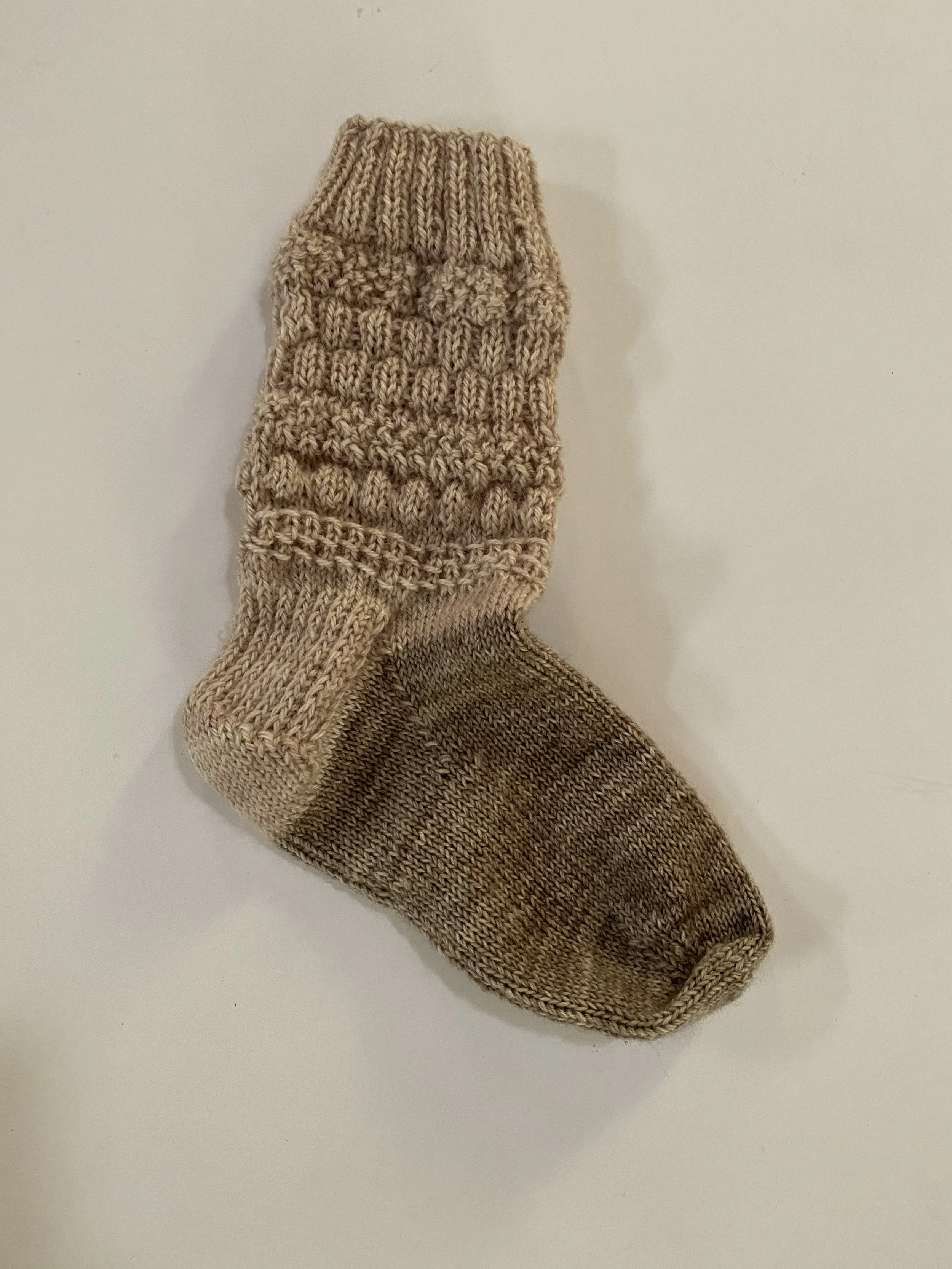
In early August of 2025, I put out a call for socks to online knitters via Facebook and Instagram -- and a few weeks later, the socks started rolling in. By the time we raised the curtain on the show, we had 45 pairs of socks. Not all of them featured code, but many of them did. Here are just a few:
The message in these socks from Norma Bingham is CANADA IS NOT FOR SALE.
The stitch patterns in this sock from Phyllis Goodfellow spell out ALLIES.
RESIST is repeated three times in each row of these socks by Elaine Anderson.
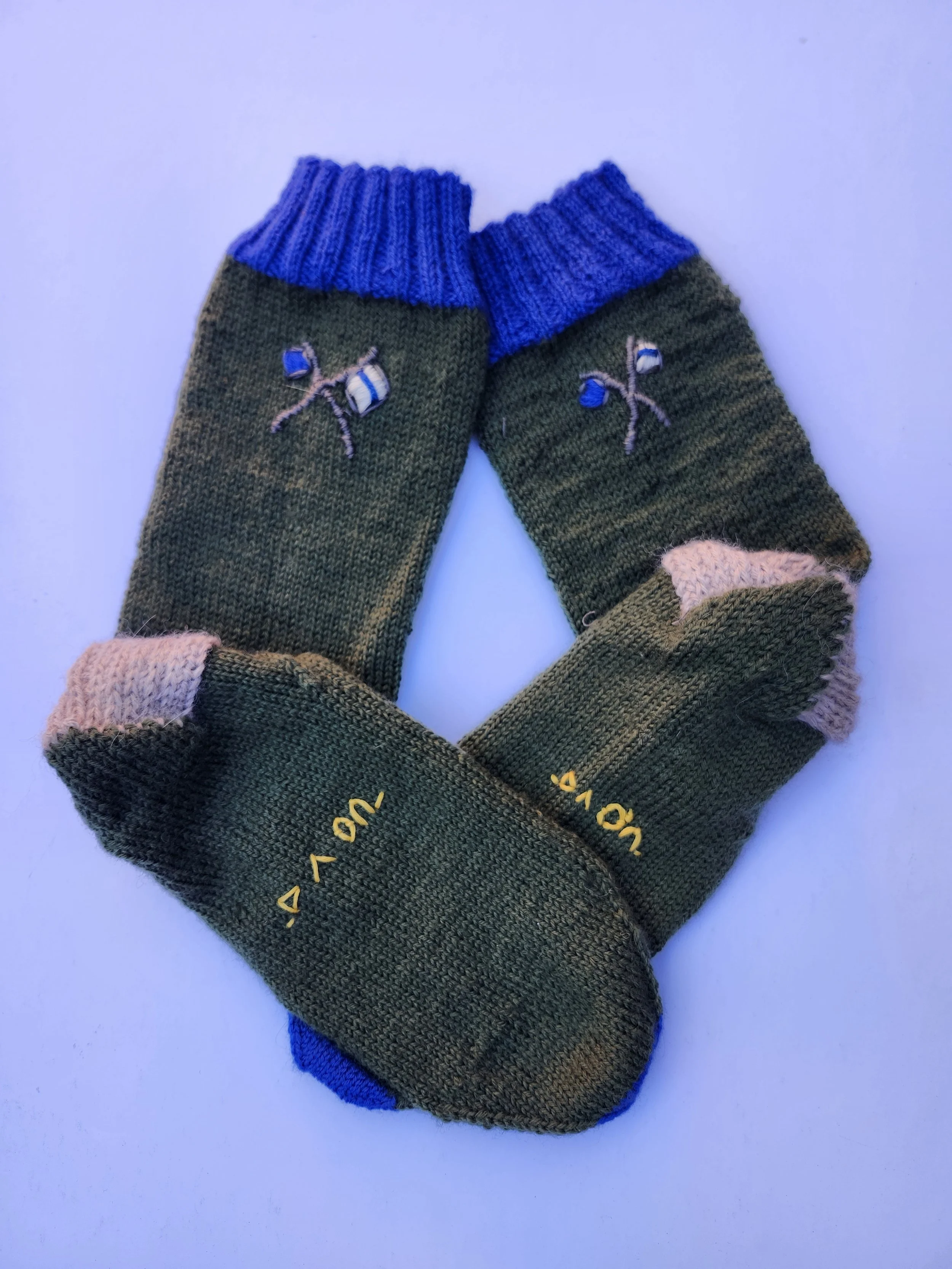
Pamela Swanson from Labrador stitched the insignia of the Canadian Army Signals Corps into the leg of these socks in the photo below. The code on the underside of the foot is in Cree, remembering the Canadian Cree Code Talkers who sent messages based in their language that the Nazis could not decipher. The messages here read JUNO and BEACH.
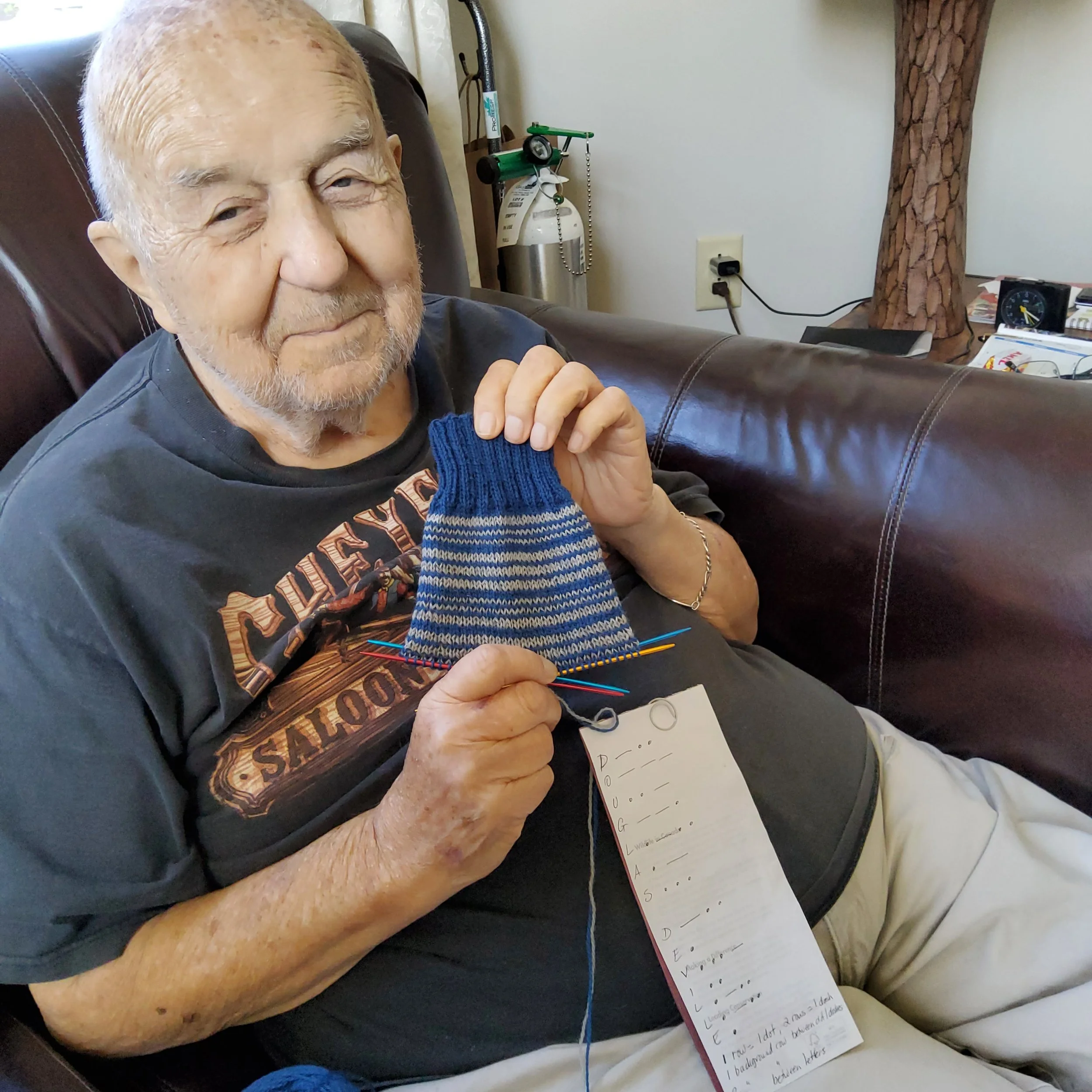
And this is Doug De Ville, who passed away at age 89 after a battle with blood cancer shortly after the photo below was taken. I did not have the honour of meeting Doug, but his daughter and fabulous knitter Cheryl De Ville told him about knitting a pair of coded socks for Spycraft, and Doug, who struggled with dementia, was all in. Turns out Doug’s mother, Winnifred, was a big knitter throughout her life and contributed many pairs of socks to the war effort in the 1940s. As a professional draughtsman, Doug was able to pick up the vertical Morse Code idea for the Spycraft socks, and he planned the code that Cheryl knitted into her socks, making them a great family project.
A huge thanks to all the knitters who participated in knitting coded socks for Spycraft. We could not have done it without you.
An update on what’s on my needles (well, just off my needles…)
As mentioned in my last newsletter, having cast off the Magpie pillow which I designed to honour the publication of Claire’s most recent (wonderful) novel, Lost in France, I was confronted by not unsubstantial task of finishing the wrong side.
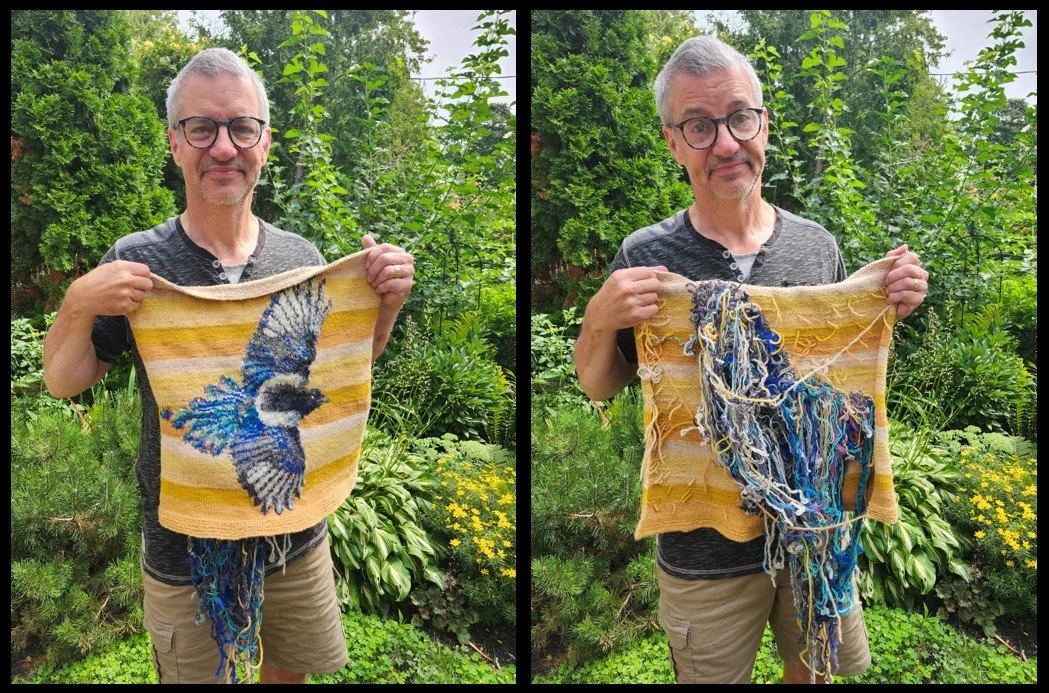
And here’s how that turned out… after 8 hours of sewing in ends.
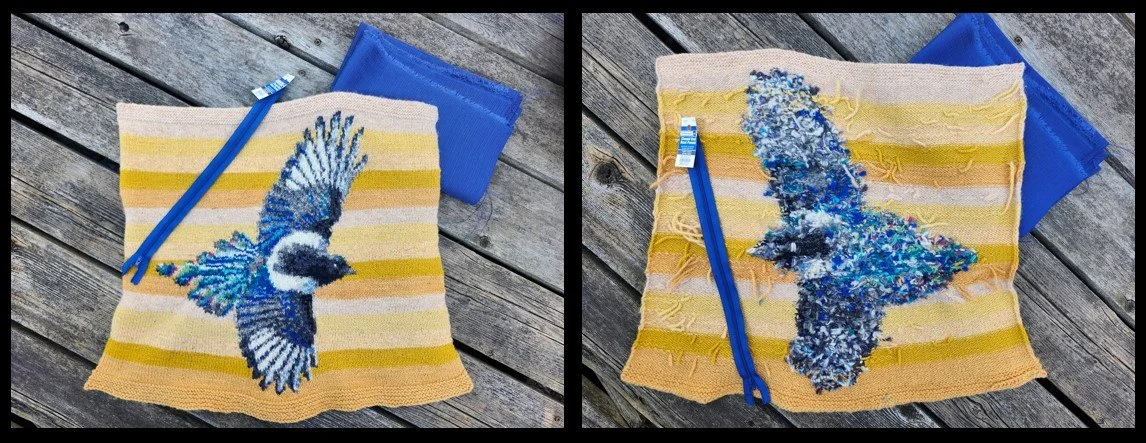
The good news is that the pillow is now being assembled. Next time, I’ll include photos of the finished product. Promise. In the meantime, you may want to buy Claire’s book as a fall escape read to see what role the magpie plays in the book. (I highly recommend the read.)
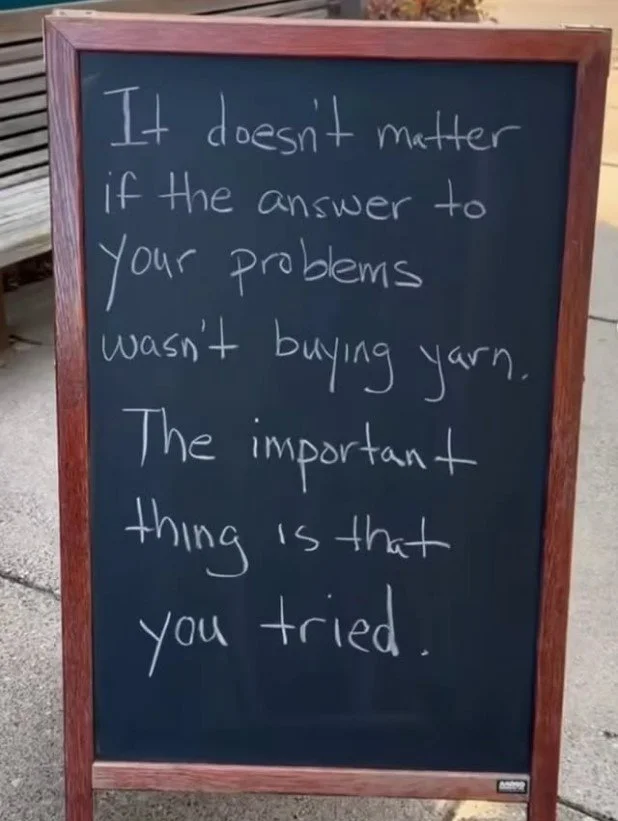
And to wrap up, here’s something that came up in my feed that made me laugh.
Keep smiling, friends… and we’ll see you next time.
Kirk