Hello friends,
I hope you’re all enjoying some beautiful summer weather.
In this edition of my newsletter, I am continuing to chronicle thee research, inspiration, and stitchery that went into the knitted costumes and props for last fall’s production of the espionage thriller Claire and I wrote: Spycraft.
But first and most importantly, for those who might not make it to the “events” section at the bottom of this novel-length newsletter, I want to highlight a fast-approaching event.
June 2, 6pm ET: “Abroad: Patchwork Pride” short documentary screening, Tranzac Club
Join us at a fundraiser for the 519 thrown by the wonderful Brenna MacCrimmon: an evening of craftivist inspiration with yours, truly. There’s so much happening! Doors open at 6, bring your knit, crochet, embroidery, quilting, and mending and enjoy a beverage from the bar. You can also contribute to and browse the stash sale table - 100% proceeds to The 519.
At 7:30pm, I will give a short talk about The Patchwork Pride Project, a giant knitted Pride flag yarn bomb which I designed and which was community knitted. Then there will be a screening of a short documentary made by content creator Neville Madill about the project’s voyage to London to be exhibited at Canada House.

Okay, back to Spycraft and a quick recap: Spycraft is about a 50-something woman, Audette Whitlock—who happens to be a hidden Jew—who spies on the Nazis in Occupied France during WWII for Churchill’s secret army, The Special Operations Executive (SOE). She battles fascism and antisemitism using her wits, mathematical and coding prowess, and (very importantly) knitting.
In my last two newsletters, we’ve covered the two vests worn two of the male characters in the play – Gerald, (played by Devin Lee), and Simon (played by Blair Williams). Today I’m going to chat about a sweater worn by one of our female characters, June (played by Charlotte Dennis).
Both vests worn by Gerald and Simon were knitted in the Fair Isle technique, a way of working with colours that uses two colours per row. When one colour is not being used, it is carried across the back of the knitting.
There’s another process for knitting with colour which allows the knitter to use as many colours as they like, whenever they like. This technique is known as intarsia. Rather than being carried across the back of the work, in intarsia, the colour is left hanging where it was last used and then picked up in the next row when the knitter knits (or purls) back in the opposite direction. A lot of knitters find Intarsia to be fiddly and even difficult. Fortunately, when I was learning to knit (to a large part teaching myself, as most knitters do), nobody told me this. So, I just did it. And because I loved using as many colours as possible, I did it A LOT. The result was that by the time I was told that it was difficult, I had gained enough skill (well, experience, really) to think it was easy. With the opportunity to design coded sweaters for Spycraft, at least one of them had to be intarsia (because that’s my jam). And because intarsia did not lend itself to being done on a knitting machine (knitting machines are best with a max of 2 colours at a time), that meant that I would have to take care of this sweater personally. I was looking forward to having some fun.
More on the ‘fun’ part later.
The first thing to do for June’s sweater was decide on a 1940s-eque shaped garment. While visiting our son Emmett in the UK, I took the opportunity to do some research at the British Imperial War Museum’s archives and thumbed through piles and piles of knitting magazines from 1939 to 1942. I found this beauty and thought it was just perfect.
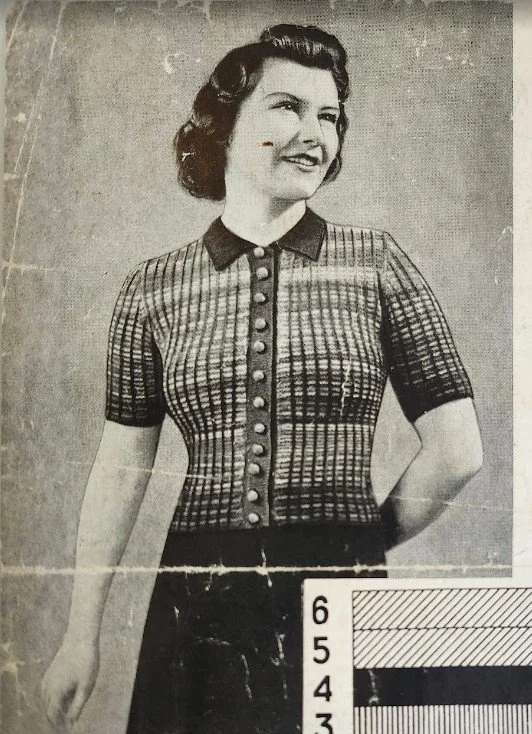
I had a trio of reasons for choosing this pattern. First, it used multiple colours, which was a very thrifty thing to do in wartime as one could use left over yarn from other projects. This worked for my plan to knit in intarsia and use plenty of hues and shades. Second, it had short sleeves, which meant less knitting (important, as I had a lot on my plate). Third, it was form-fitting, which meant it would be a comparatively small size (again, less knitting) and stretch to fit. These three attributes left me feeling very clever.
Next, we needed to come up with the code embedded in the garment, and how to hide it. I had decided to use Morse code in Audette’s sweater (which will be covered in the next newsletter), and I had used bands of classic Fair Isle design to stand in for letters in the vests for Gerald and Simon, so I was looking for something different this time around. Because I’m such a big fan of colour, and because intarsia would support as many colours as I could throw at it, I decided to assign a colour to each letter in the hidden message in June’s garment. I used my favourite Sport Weight yarn from Canadian company Briggs & Little because, not only did it come in a wonderful range of colours, but it was also historically accurate as Briggs & Little was in operation during the Second World War.
June’s vocation was as a secretary in the SOE, so we called her sweater the ‘Secretary Sweater.’ Claire and I decided on a quote that would be suitable for the character, and immediately below you can find the basic pattern I worked from along with the legend to the code if you’d like to work the message out for yourself. If you want to skip the puzzle, the quote is revealed in the following paragraph.
Read the code starting at the bottom left and moving to the right, then up to the next row of colours, and so on.
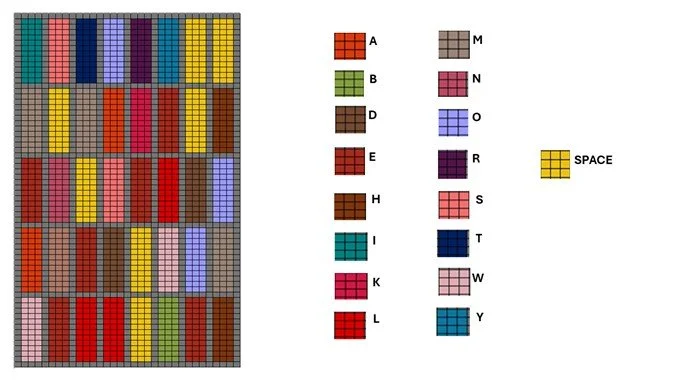
The character of June, by the way, is a young woman from the British working class who does not suffer fools gladly. She witnessed how the Great War impacted her family and her society and has little patience for the patriarchy that has led her country into another global conflict—and is presently making a balls-up of it. June is a disruptor. We chose a quote from Laurel Thatcher Ulrich to be her motto: Well behaved women seldom make history.
Here's what my first sketch looked like:

I felt the blocks of colour were a bit squat, so I tightened them up and made them a bit taller. Here’s what the pattern I created on my Stitch-Painter Gold Software looked like. Truth be told, I didn’t need to follow the printed pattern much. Once I had been through the entire message once, I just repeated the sequence of colours, so that was pretty straightforward.

What was NOT straightforward was the sizing of the sweater. Usually I work from graphed patterns that someone else has already fit to the human body. But the 1940s pattern I had chosen as my model didn’t have a chart. Here’s what its instructions looked like:

I am not accustomed to following written patterns. This one was written in the 40s, and I was changing it from Fair Isle to intarsia. Added to that, I had no way of knowing whether the sizing of this pattern would fit our wonderful actor, Charlotte. I figured I’d just boldly go, and see what happened. Here’s a photo of the back panel of the sweater in progress:

And, because all knitters want to see the wrong side of the knitting, here’s what the other side looked like:
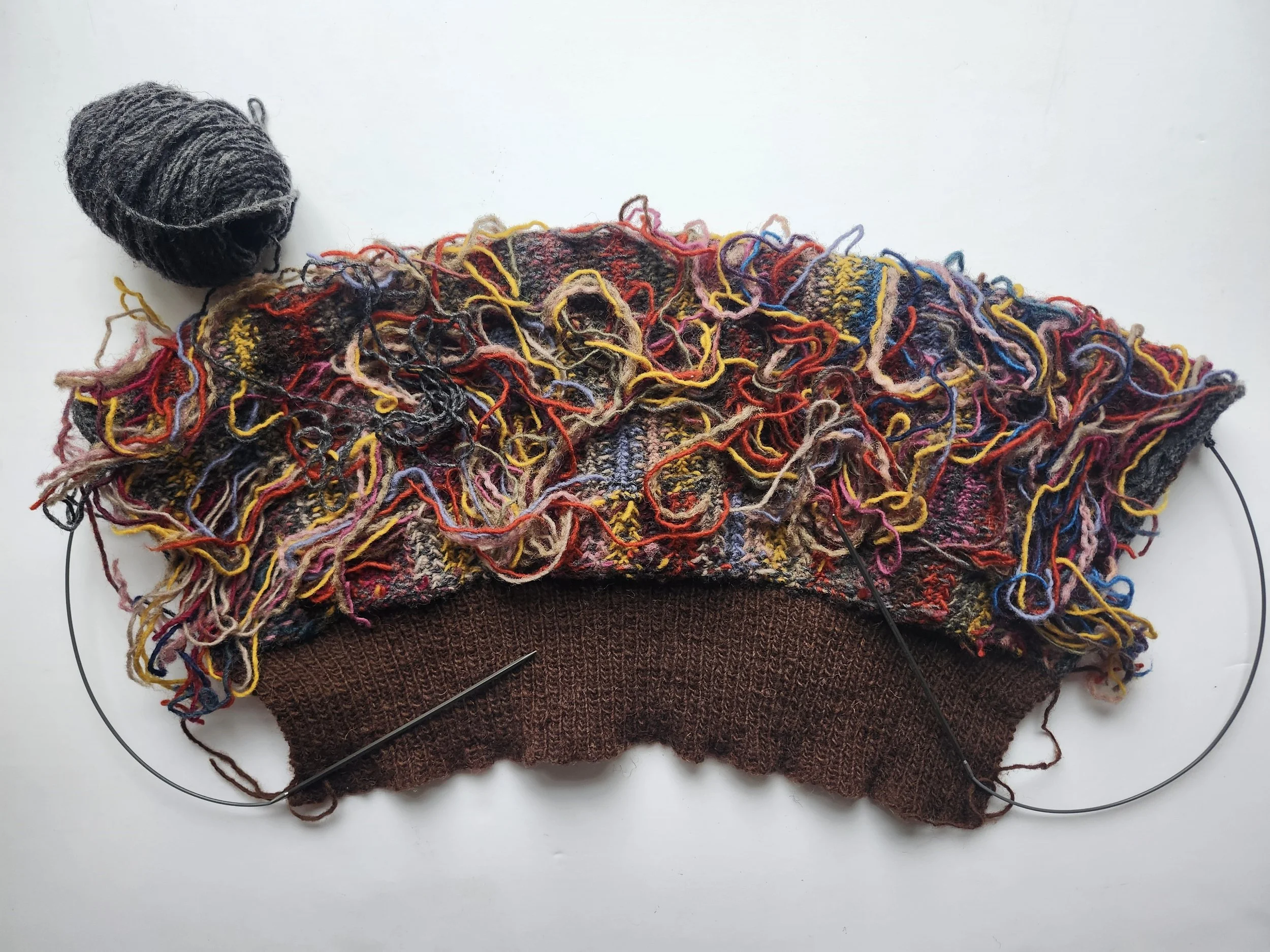
That rat’s nest of loose ends tends to give knitters the willies. My habit is to work them in as I go, so it’s really not as bad as it looks. All I really need is a few minutes with a pair of scissors, a few snips here and there, and everything will be neat and tidy.
Once I had the back finished, it was time for a fitting. That’s when I discovered that the ‘form-fitting’ attribute of the sweater was not going to make things any easier. The original 1940s design, The Rainbow Jumper, was knit in the Fair Isle technique with two colours per row being carried across the back in nice big loops, which meant it was stretchy. So, if it was a bit small, it could stretch to fit. My Secretary Sweater was knit in intarsia and had practically no give to it all. So, there would be no ‘stretching to fit.’ It would need to fit exactly. Of course, it did not.
Here is a shot of the very patient Charlotte enduring one of a great many fitting sessions.
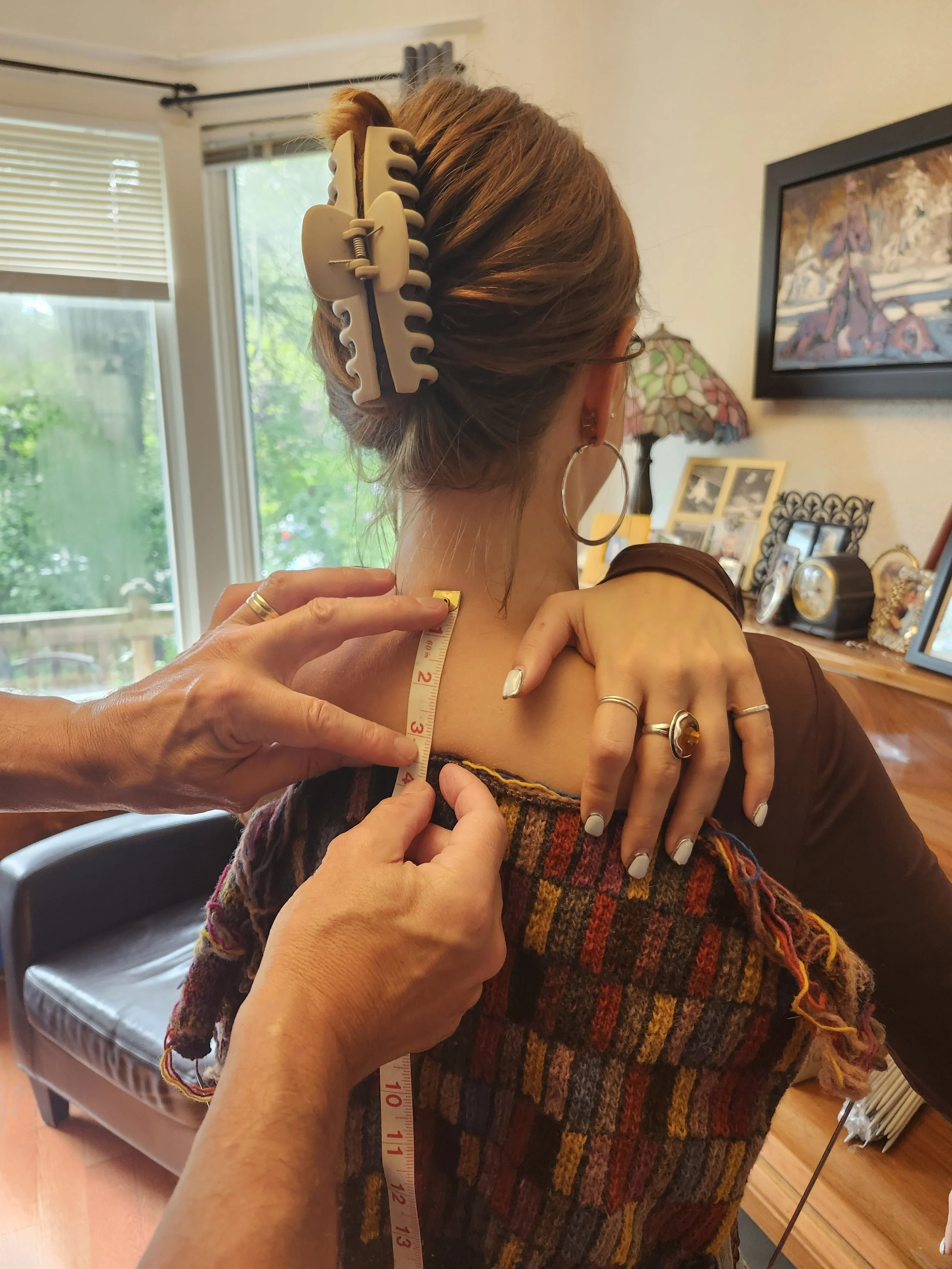
The fitting of this sweater gave me fits. Because I could not get it right, and I still wanted the code to be read correctly seam to seam across the garment, I was obliged to do a serious amount of frogging. “Frogging,” for those non-knitters in the crowd, is what knitters call it when they have to rip out their work. It’s a play on words: “Rip it” = “Ribbit” … thus the association with frogs. Here’s a couple of shots of me engaged in the activity. Note my sunny demeanour.
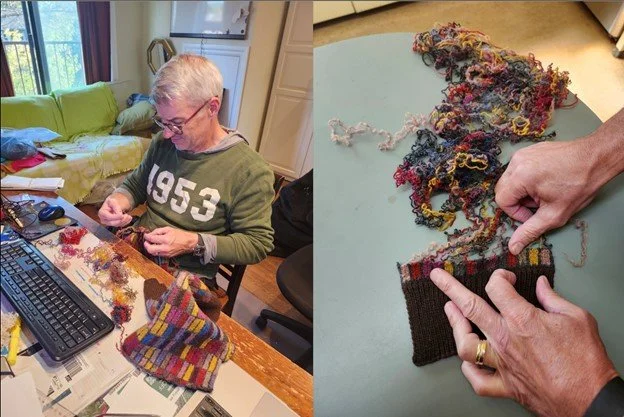
Meanwhile, the clock was ticking, and I was feeling the pressure. Though I was attending rehearsals, I spent all my time knitting in the back of the hall. Eventually, I just ran out of time. I did succeed in knitting all the pieces of the sweater, but they did not fit together properly. Admitting defeat, I handed the various sections to our fantastic head of wardrobe, Émilie Beaudry-Levesque, and invited her to make it fit. This meant cutting the various panels into shapes that would fit Charlotte and then sewing them together. Cutting knitting is known as ‘steeking,’ and it is not for the faint of heart. Claire had to literally turn away because she’s never seen steeking and she feared the worst.
Here's a picture of two panels ready for steeking. You can see the safety pins marking the line the future seam where the sleeve will attach to the body.

Sadly, a not insignificant amount of knitting ended up on the cutting room floor. The pieces below represent hours and hours of work, but that’s life.
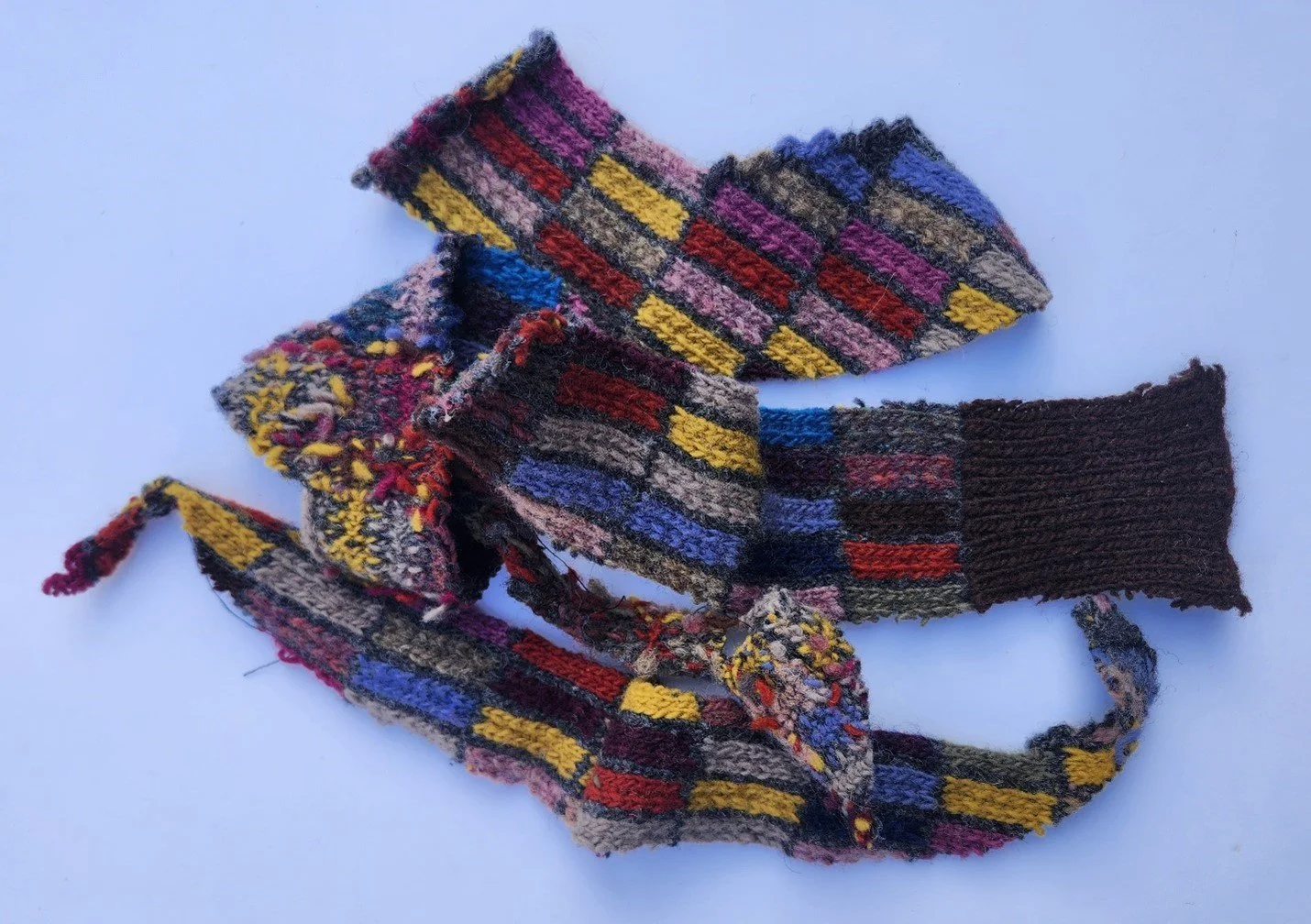
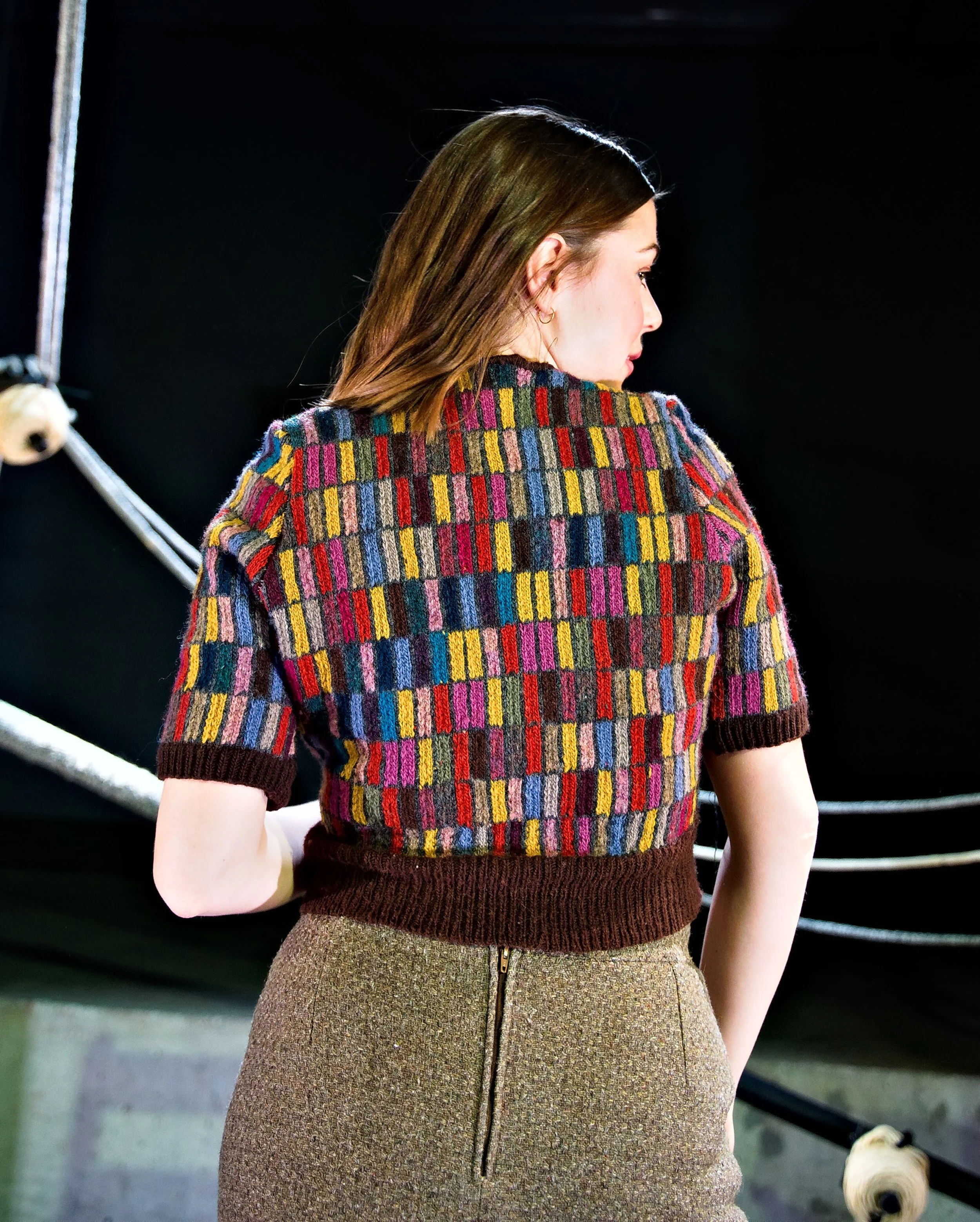
On the other hand, thanks to the wardrobe wizardry of Émilie, the Secretary Sweater turned out very well. Below are a couple of photos of Charlotte in the final product.

Next newsletter, I’ll cover the design and knitting process for the Diamonds Sweater worn by Spycraft’s lead character, Audette, June, played by Diane Flacks.
Coming events
Tues, June 30, 6-8pm: The Lost in France Book launch - SAVE THE (NEW!) DATE
The Book Launch for Claire’s new novel Lost in France has moved dates. The book’s official pub date is June 23, and moving the launch to June 30 means you have time to collect your book and bring it to the launch party and have it signed by the author!
Come get Lost in France...by way of Ireland. Or at least at a great Irish pub, our local: Noonan's Irish Pub at 141 Danforth Avenue (between Broadview and Chester Stations, south side of Danforth).

Thanks for reading, friends. Looking forward to next time.
Kirk