Hello friends,
Happy spring to us all!
As I type this, winter is taking a few last kicks at the can here in Toronto. But, despite those final flurries, the snow drops are poking their heads up out of the earth in our front yard. Spring is on its way.
I promised to backtrack a bit and catch up on all knitting busy-ness I did not manage to share during the wild ride Claire and I had writing, funding, producing and touring, last fall – our play Spycraft, so I will continue that process here.
Also know that at the bottom of this missive are notices of a few upcoming events I want to share.
So, first, more about knitting and Spycraft.
The Spycraft Knitting Diary: Gerald’s Lions Vest
The show was a huge success (phewf!) and a whole lot of work. In my next few posts, I’m going to talk about the knitting side of all that, sweater by sweater, prop by prop.
Spycraft, as a quick recap, follows the exploits of our heroine, Audette Whitlock, a 50- something hidden Jew who spies on the Nazis in Occupied France for Winston Churchill’s Special Operations Executive (SOE), and passes coded intelligence back to the Allies in her knitting.
In such a show, of course, we would want as many costumes as possible to be knitted. And, because the show is all about espionage and code, why not embed coded messages into those knitted pieces?
Nick Blais (who designed the set, lights, and non-knitted costumes) was thrilled with this idea. He told us, “This is such a treat – we never get customized knitted wardrobe in the theatre!” And friends, now I know why: theatre’s timeline and a knitter’s timeline just don’t get along. Once rehearsals start, you’ve usually got about three weeks until the show opens. We had five sweaters to design, knit, and fit to four different actors. Yikes. We had to start early, and we had to have help.
Luckily, at the PEI Fibre Fest in October 2025, I connected with Lynne Pascoe, proprietor of Sheep’s Clothing in Nova Scotia.
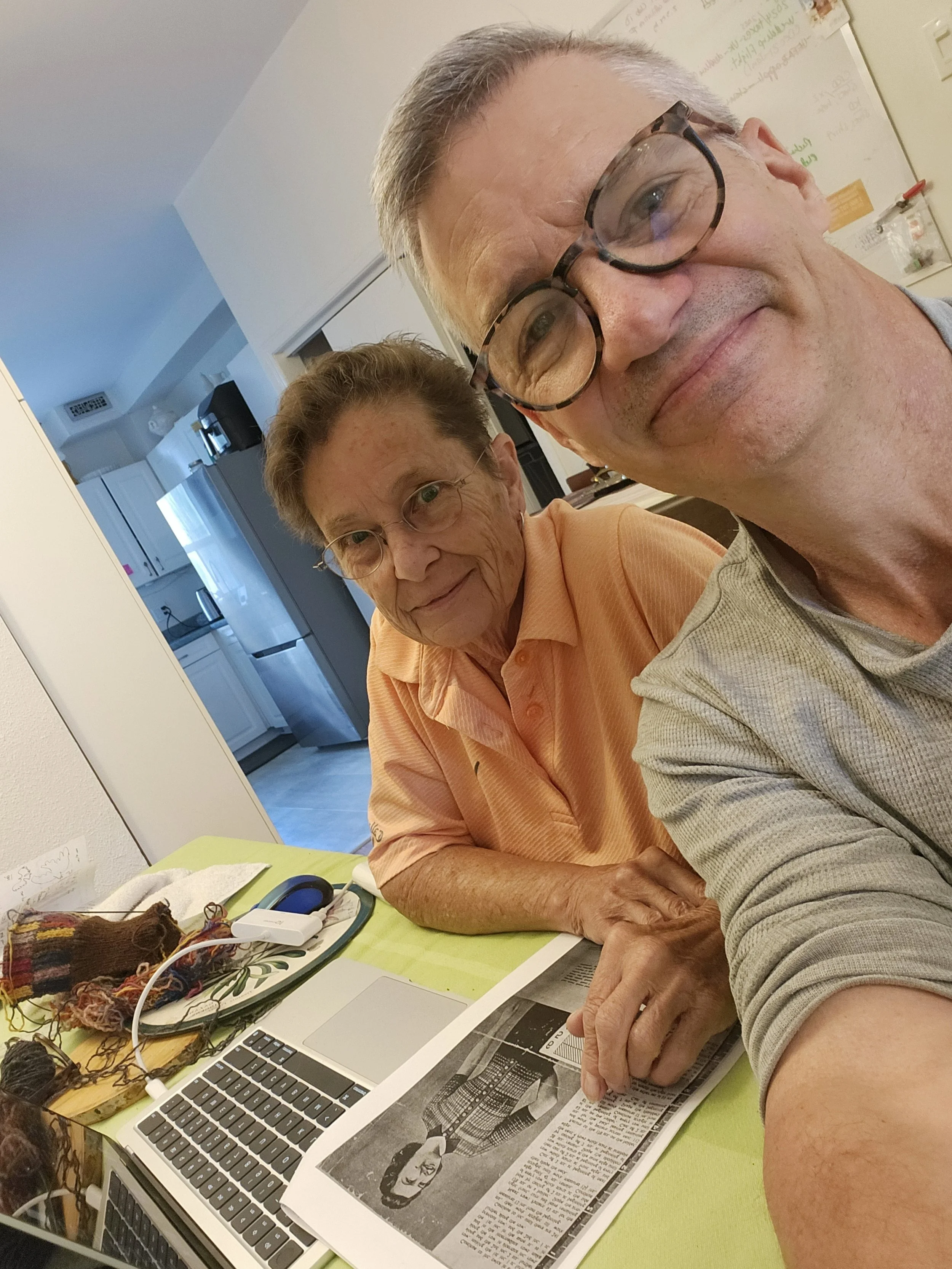
Lynne’s specialty is machine knitting historical knitwear, and she’s done a lot of work on patterns from the 1940s. Yes, it would have been nice to be able to hand-knit all our sweaters, but there was just no time. Lynne and her knitting machine very much saved our bacon.
The first sweater we tackled was a waistcoat for the character of Gerald, the young deputy director of the SOE, played by Devin Lee. Lynne’s knitting machine could handle two colours per row, so a Fair Isle pattern seemed to be the way to go.
In order to hide a coded message in the design, I figured the thing to do would be to distract the eye from the code by featuring some uncoded representational images to pull one’s focus away from the coded areas. And since the SOE’s recruited agents were from across the British Commonwealth, I played with symbols of some of the countries involved. Here’s what my first Fair Isle sketch of those icons looked like, using Briggs & Little Sport yarn:
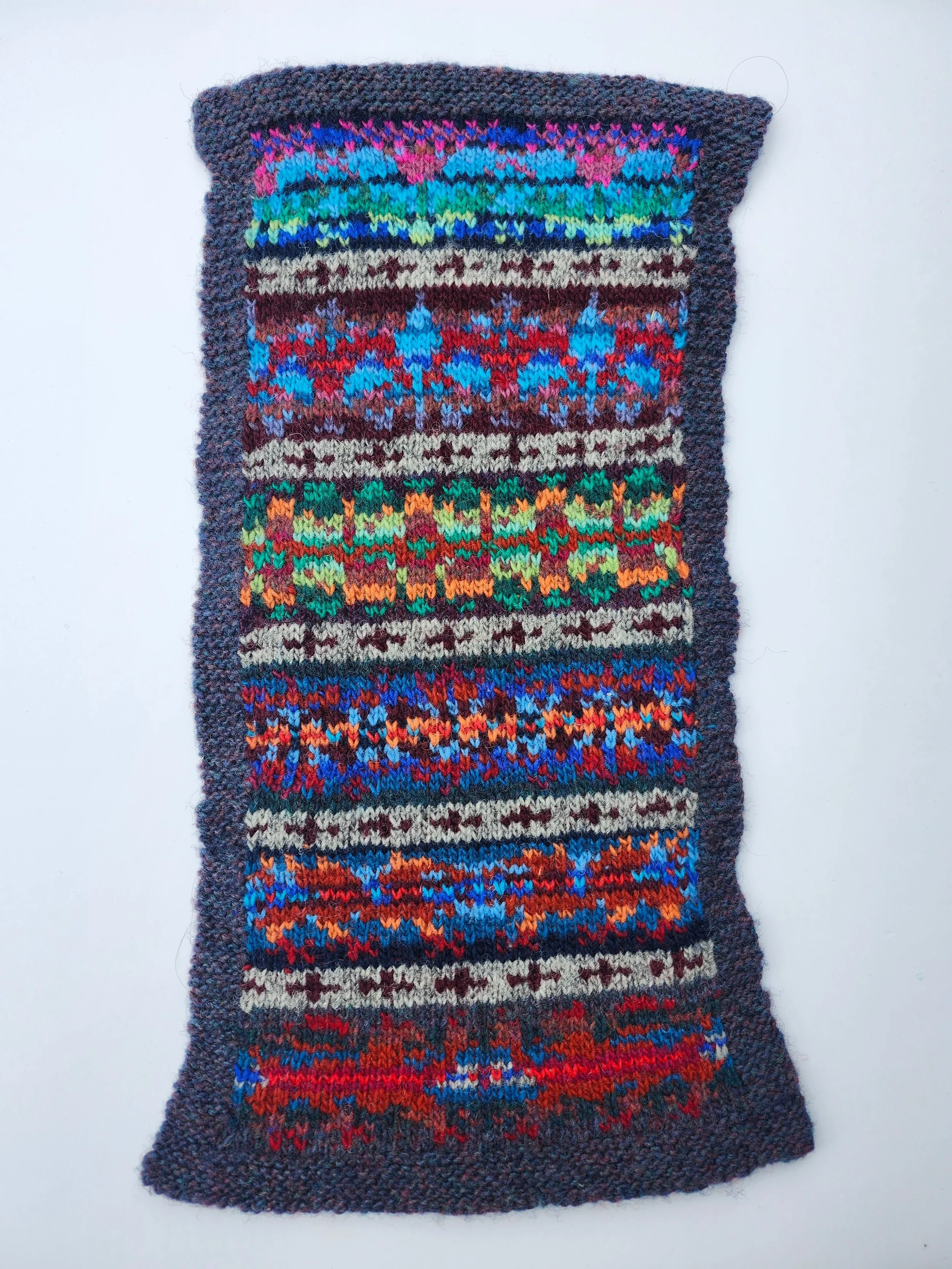
Bottom to top: Lion (England), Dragon (Wales), Maple Leaf (Canada), Shamrock (Ireland), Fleur de Lis (France), Thistle (Scotland)
In keeping with the idea of code and hidden messages, this first sketch played with obscuring the images through colour choice, and, in the case of the shamrock and the maple leaf, flipping alternating icons vertically so that you really had to look for them to pick them out. This worked a little too well and I found it was difficult to see anything.
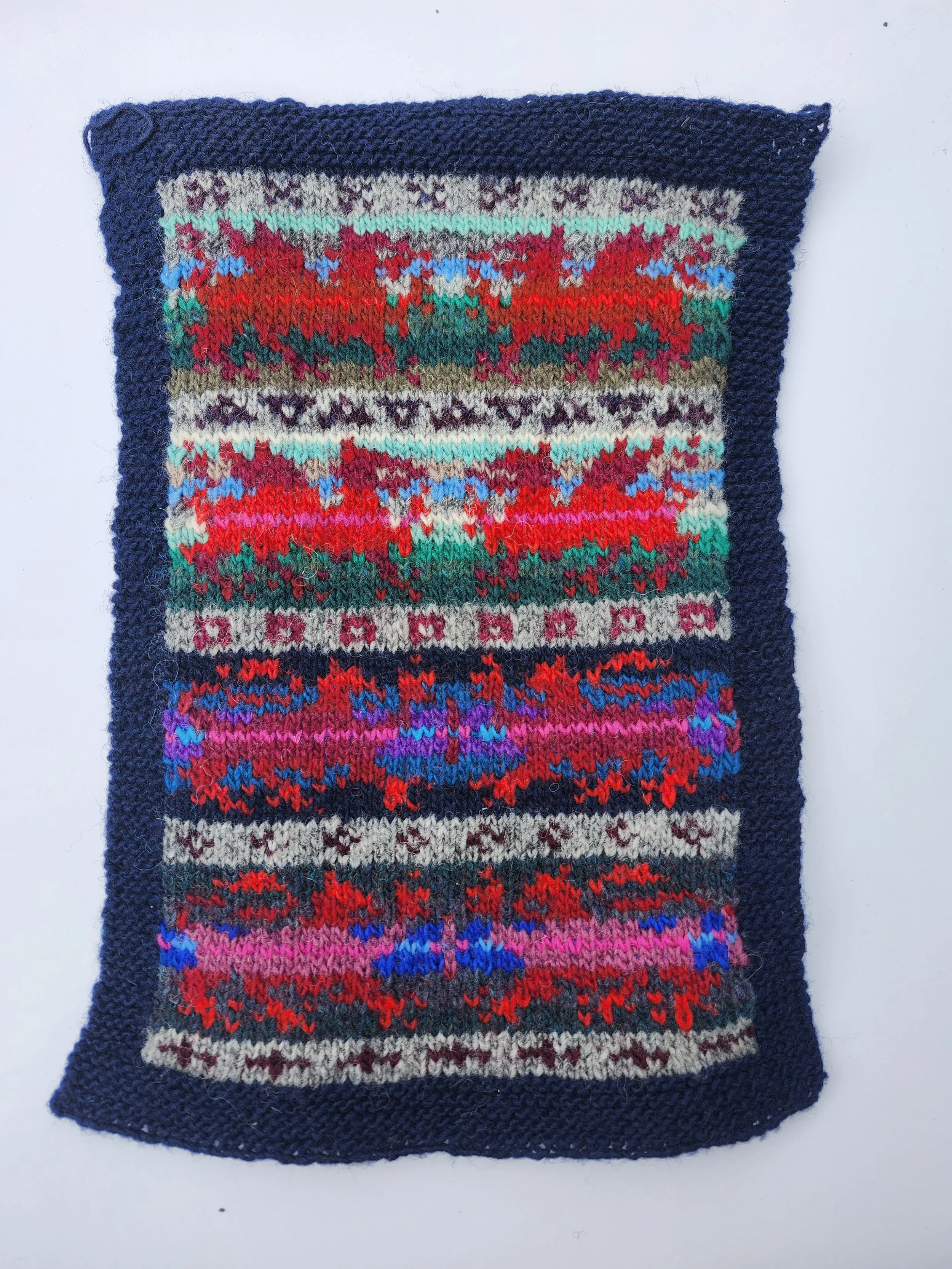
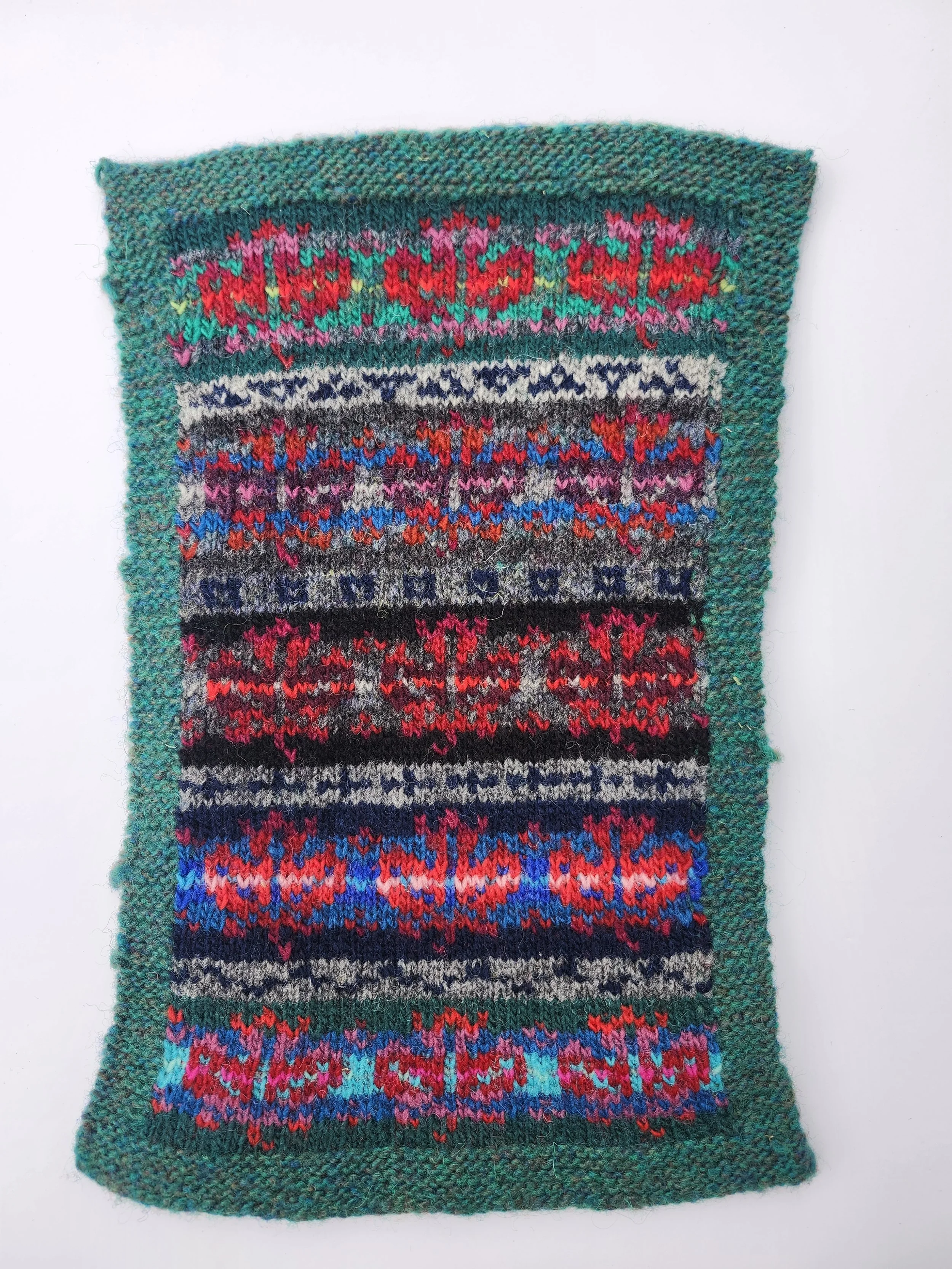
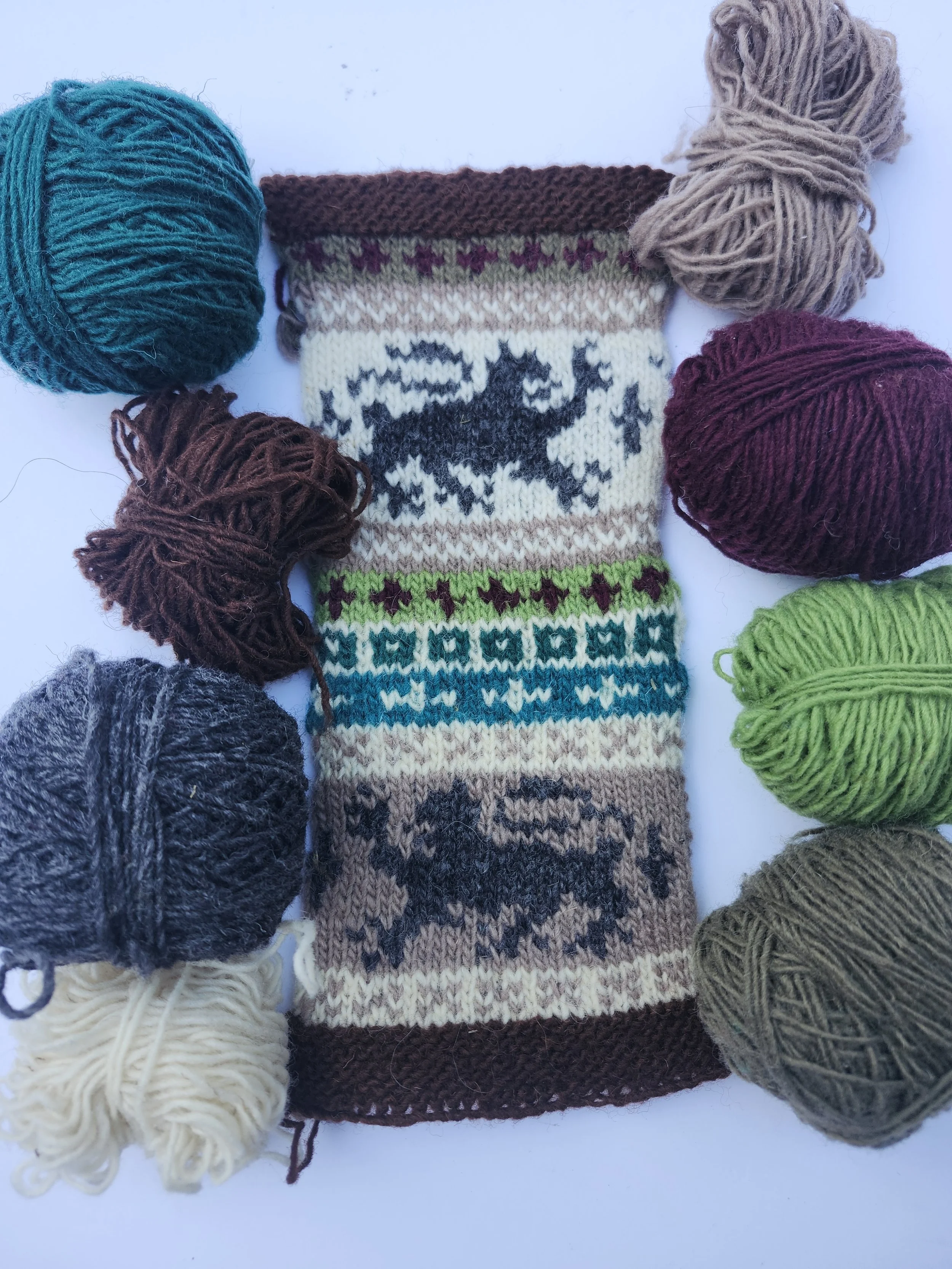
So, I tried again, keeping everything right-side up, and choosing colours that made the icons easier to see. First, with the lions and dragons:
And then, with the maple leaves:
In the end, I went with the lion icon for Gerald’s waistcoat and kept the lion band to a simple two-colour palette for clarity.
I hid the coded message of the piece in the five-row Fair Isle bands that separate the bands of lions. Each five-row band corresponds to a letter (well, one of them represents a space), and the message is read from bottom to top. Below is an image of the pattern I designed using Stitch Painter Gold software by Cochenille Design Studio. Beside the coloured chart I’ve included a legend for the message if you’d like to puzzle it out (spoiler alert: the message is revealed immediately below the pattern, if you can’t wait):
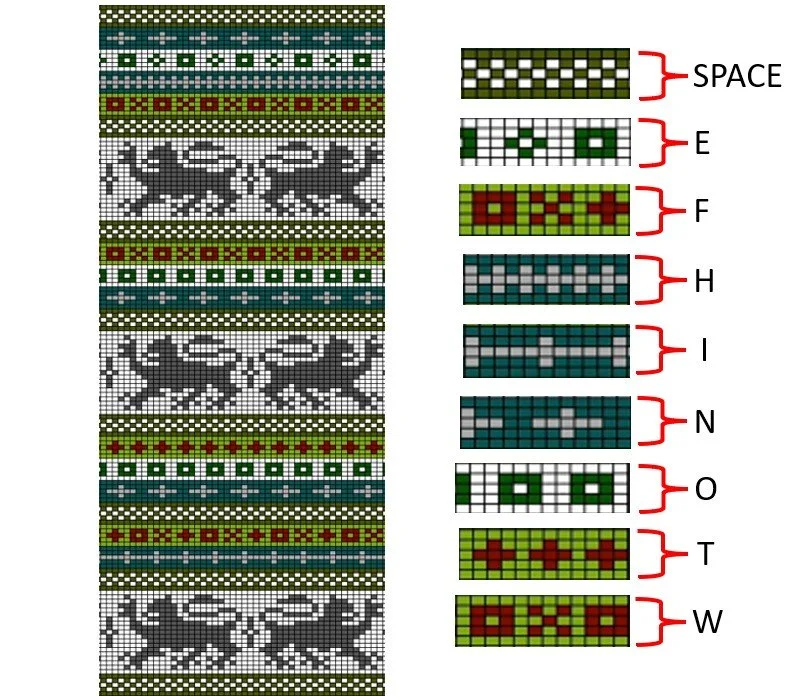
In choosing the message, Claire and I thought about Gerald and his role in the play as a young innovator and decided on “If not now, when?” Which, in addition to echoing Gerald’s ‘get it done’ attitude, is also one of Rabbi Hillel’s three questions, so it works with the hidden Judaism theme of the show as well.
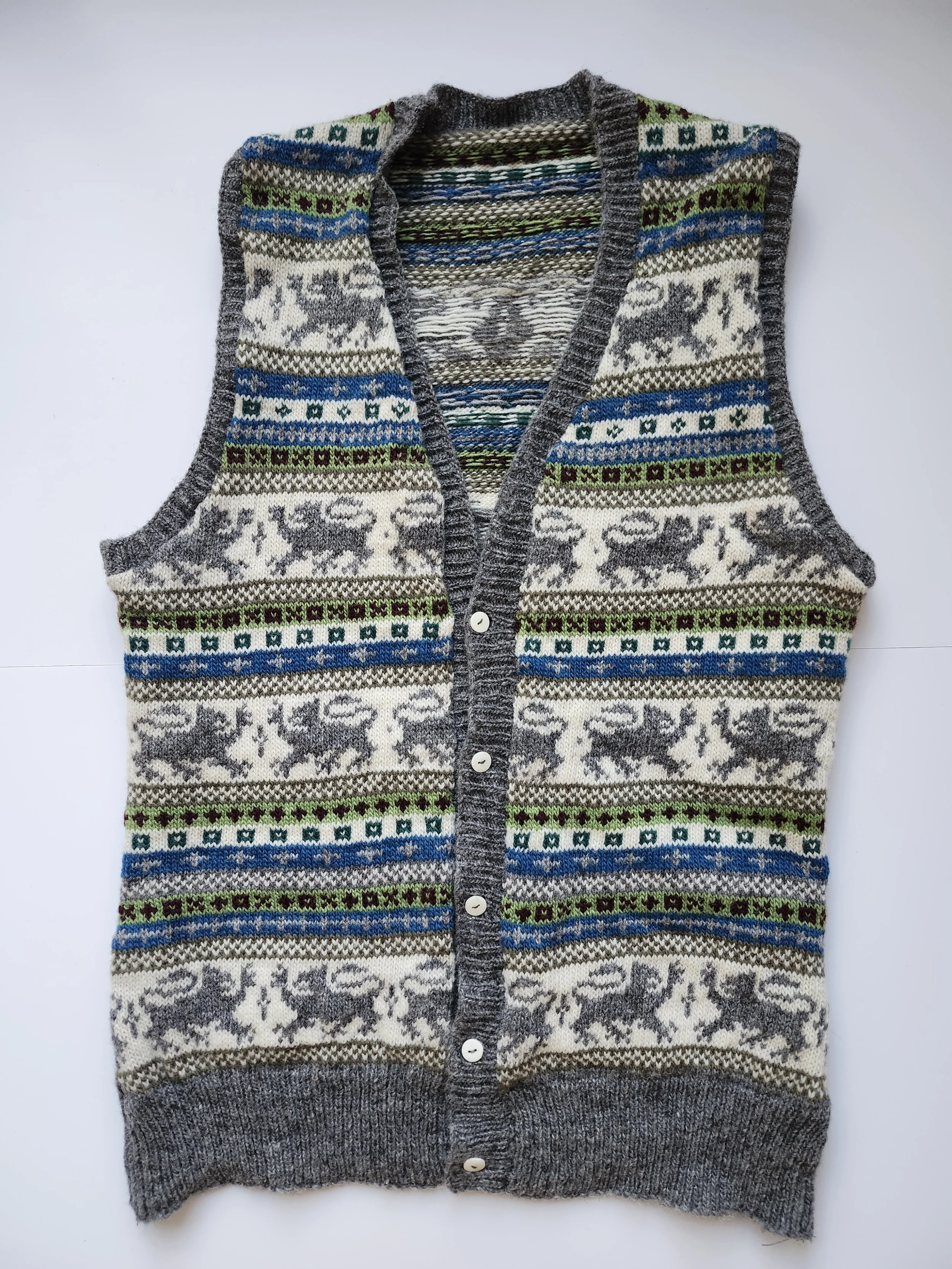
I sent the repeating section of the pattern off to Lynne, who came back with a beautiful rendering of the back.
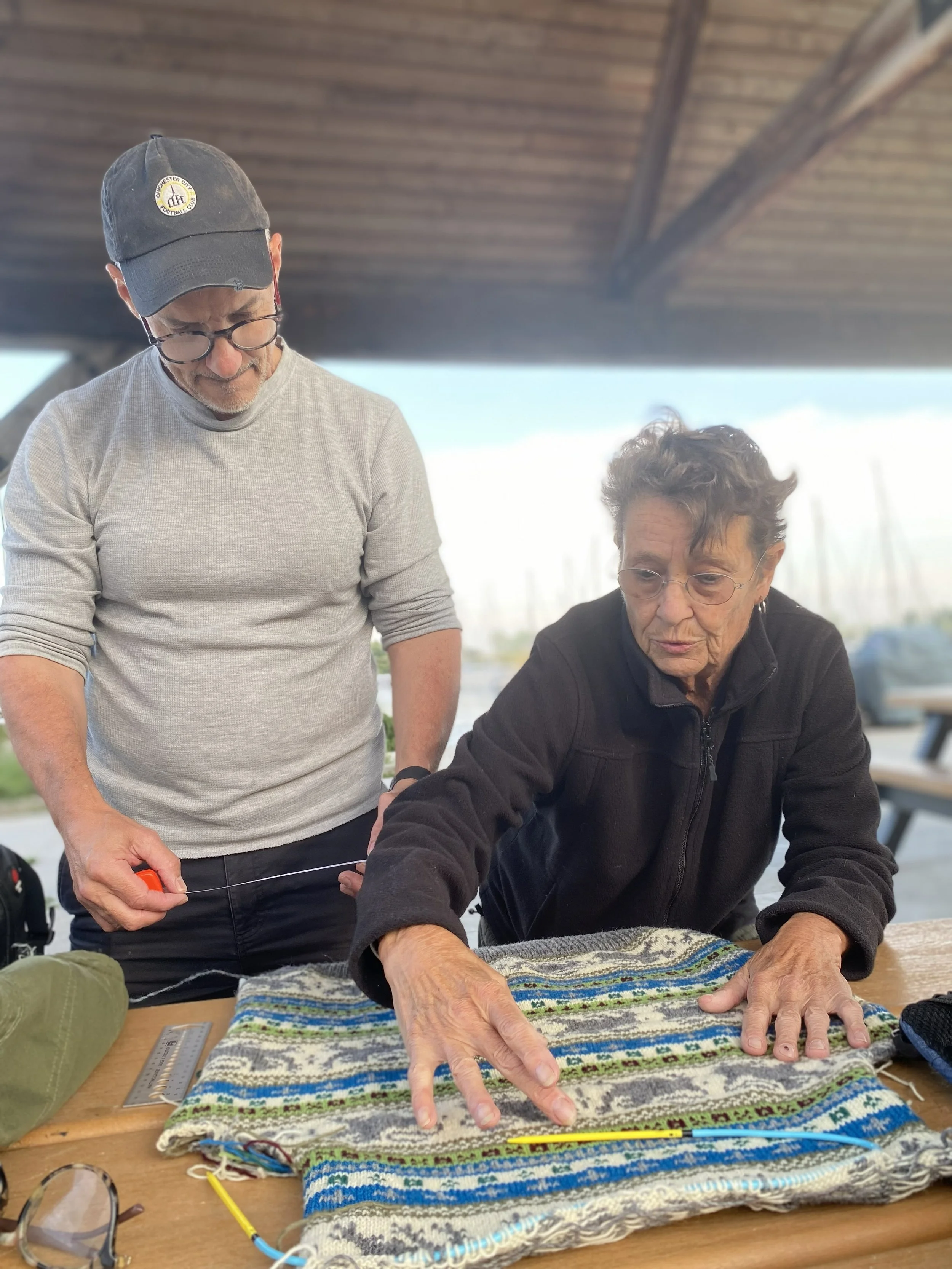
And here’s how it turned out:
Gerald’s waistcoat on stage:
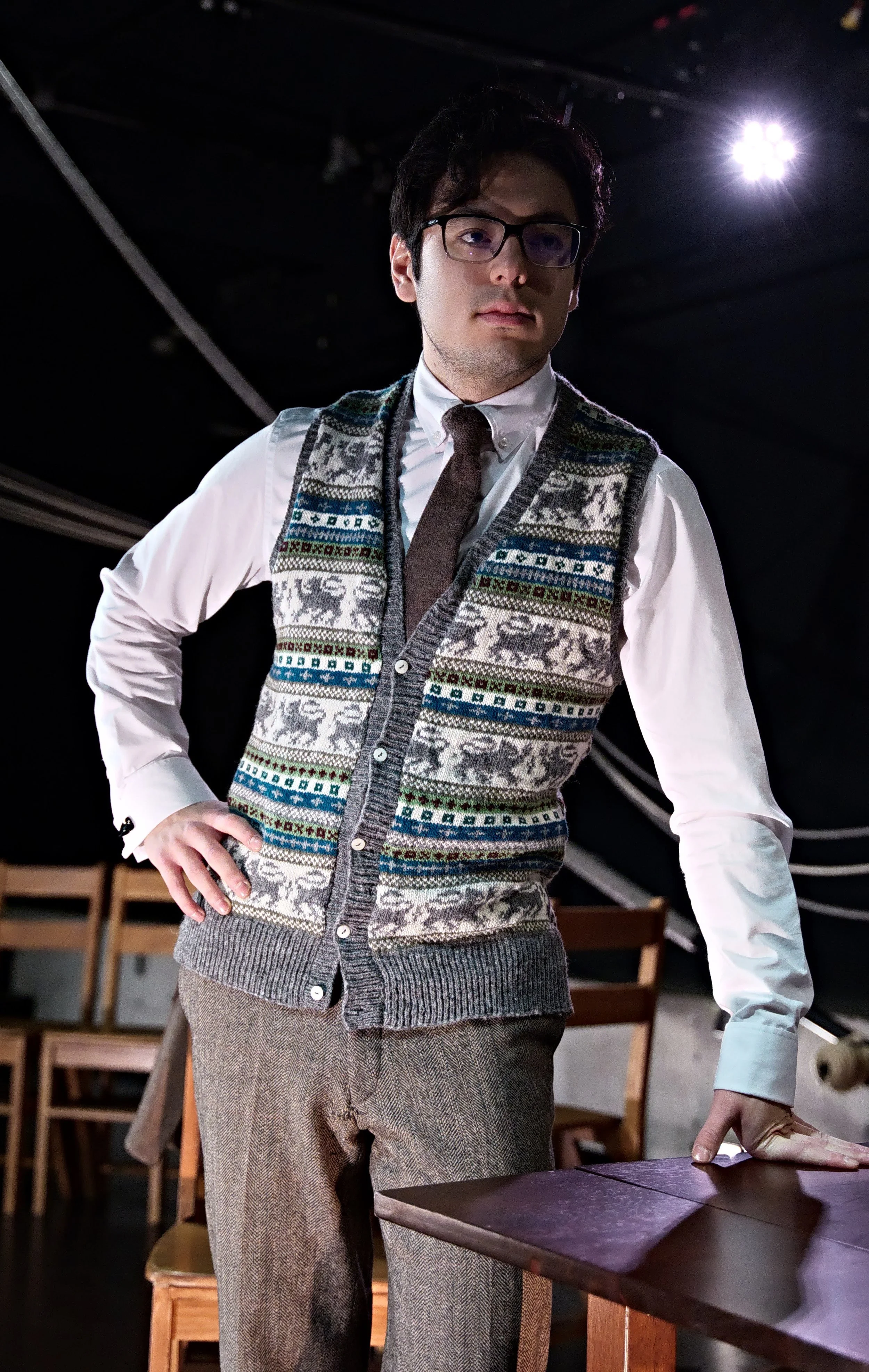
Devin Lee as Gerald, Spycraft. Photo Credit: Heidi Chan
The vest looked fabulous on Devin. I’ll say that the other really hard thing about knitting garments in such a short timeline is sizing. When Devin first tried on the vest, it was quite baggy on him, and my heart sank. Even though Lynne and I had been very careful with measuring the actors, you never quite know about tension and gauge and how it will work out—and the experience of producing garments through machine knitting was brand new to me. So, there we were: the vest was at least a size too big for Devin, if not two. With almost no time left, we turned to our amazing Assistant Designer and Head of Wardrobe Émilie Beaudry-Levesque and asked if she could alter it. Which she did beautifully. We were also assisted by the ever-wonderful Phyllis Goodfellow who came in to make tiny adjustments and sew in ends. It takes a village, that’s for sure.
Next newsletter, I’ll share the design and knitting process for the SOE vest for the Spycraft character of Simon, played by Blair Williams.
What’s on my needles now
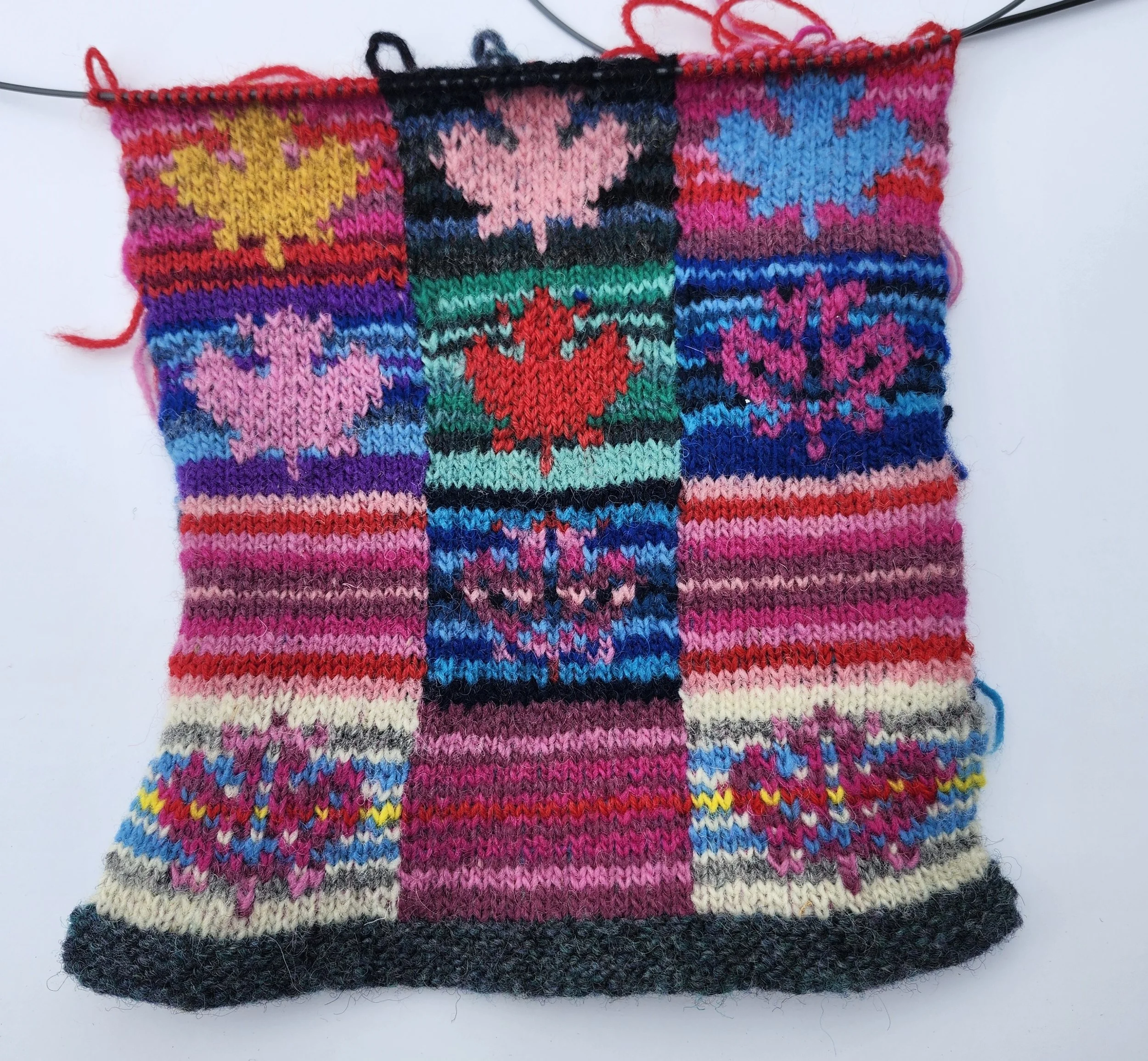
There has been some silliness floating around in recent months about the thought of a certain 51st state. I’m looking at knitting a vest that pushes back against that idea. I may call it “Tell me you’re Canadian without telling me you’re Canadian.” It features a version of the maple leaf icon I played with for Spycraft, mentioned above.
This sketch below is in Briggs & Little Sport with the limited number of colours that I brought on our recent 7-week European trip to work on Claire’s Lost In France pillow (see my last blog).
Looking forward to digging into my stash (or what Claire would eyerollingly call The Canadian National Yarn Reserve) to try out more colourways.
Speaking of Lost in France…
There is a 25% off Preorder sale of Claire’s next book, Lost in France, at Barnes & Noble.
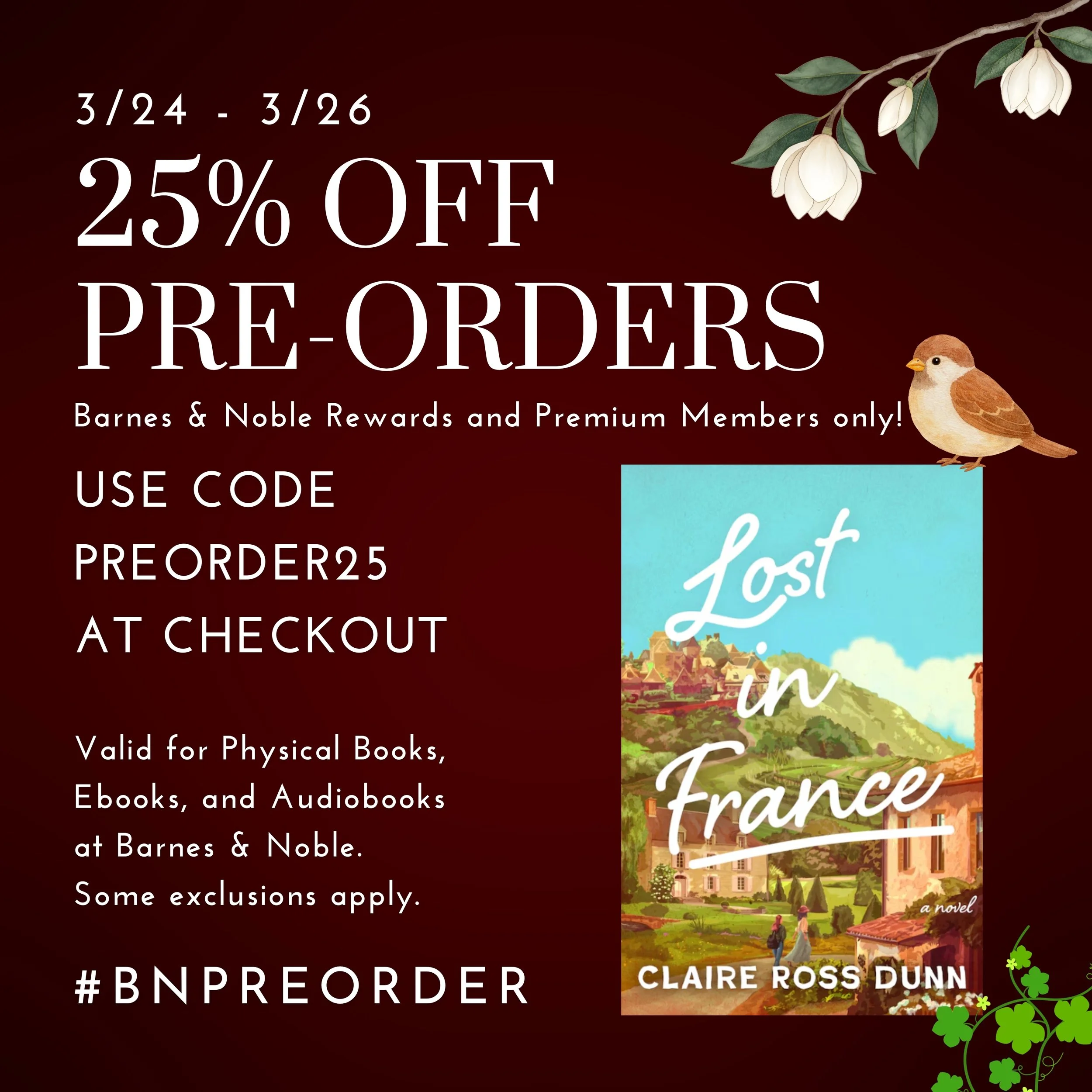
It comes out via Alcove Press on June 23, 2026, but pre-orders are available, and right now, Barnes & Noble has a special 25% off promo running Tuesday, March 24 to Thursday, March 26, including audiobooks and eBooks. Premium members get an additional 10% off print book pre-orders. If you’re in the US, I hope you can take advantage of the sale.
The Code is PREORDER25.
Here’s the link to the book on the Barnes & Noble website:
Lost in France via Barnes & Noble
If you aren’t in the US, the book is also available to pre-order in Canada and elsewhere, via whichever platform or bookstore you choose.
Upcoming Events
Sunday, April 19 at 3pm: I will be performing The Knitting Pilgrim at Aurora Town Square’s Davide De Simone Performance Hall. I think it’s our 122nd performance, which is a bit hard to believe. Here is the link for tickets. If you haven’t seen the show, please come—I think the show is already half-sold, so now’s the time to book. It’s a great way to spend your Sunday afternoon. And don’t forget your knitting (if you’re the kind of person who has some knitting…) If you’re not, you’ll enjoy the show, too, I promise.
Tuesday, June 2, 6pm: Screening of Neville Madill’s documentary “Abroad, Patchwork Pride” at The Transac Club – doors open at 6:00, screening starts at 7:30. The film is about my journey to bring The Patchwork Pride Project to the UK to exhibit it on the façade of Canada House in London’s Trafalgar Square.
Sunday, May 17, 2:00pm: I will be giving an online presentation about Spycraft to the Center for Knit and Crochet digital museum. If you’d like to attend, you’ll need to become a member. Membership is $10 US and includes access to the online museum, study centre, and social networking environment. For tickets to the talk, click here.
Thanks for reading, friends. Looking forward to next time,
Kirk